

Choosing the best thermal scope for hog hunting is not as simple as buying the optic with the highest sensor resolution or the largest objective lens.
Base magnification, field of view, thermal sensitivity, image processing, performance in humidity, display quality, controls, weight, battery system, rangefinder placement, and expected shooting distance all matter once you leave the specification sheet and start hunting after dark.
I have spent years hunting hogs and predators at night in Texas and using thermal optics under real field conditions. The recommendations in this guide are based on image quality, practical shooting distance, target identification, handling, reliability, and overall value—not simply manufacturer advertising.
There is no single perfect thermal scope for every hunter. A scope that excels at long-distance target evaluation across an open field may not be the best choice around feeders, thick vegetation, narrow shooting lanes, or groups of running hogs.
My goal is to explain which scope I would choose for each type of hunting, where each model is strongest, and what tradeoffs come with that choice.
Disclosure: Huey Outdoors sells many of the thermal scopes discussed in this guide. These rankings represent my own field experience and opinions. They are not paid manufacturer placements.
Last updated: October 2026. This guide covers thermal scopes that are currently available and that I have personally used or evaluated. It will be updated as new models are released and after I have enough field time to evaluate them properly. I do not rank unreleased or untested thermal scopes from manufacturer specifications alone.
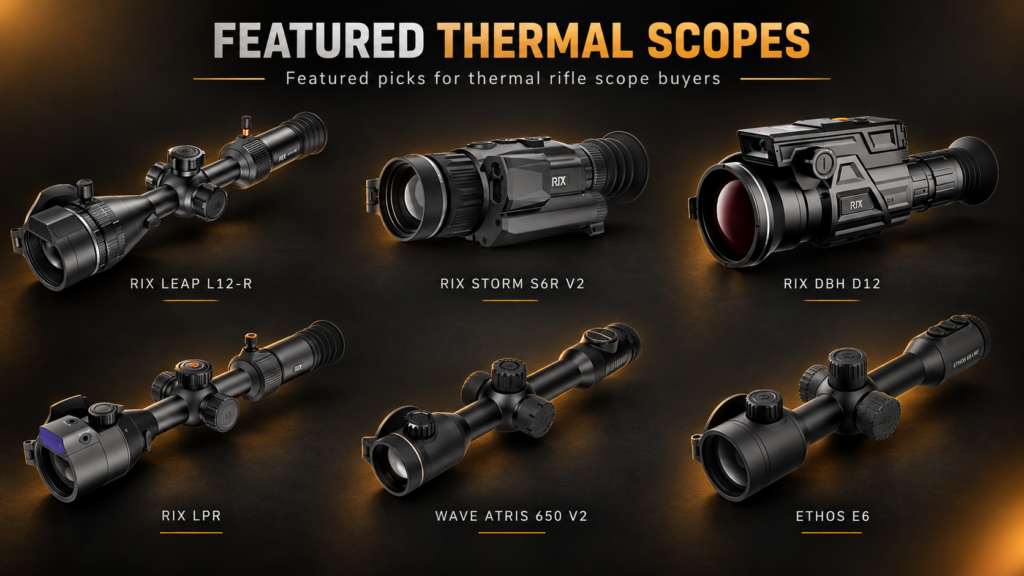
The DBH D12 is my best overall choice, best premium 1280 thermal, and best long-range thermal scope. It has produced the best thermal image I have personally seen and has performed exceptionally well in difficult Texas humidity. It gives you the same 3× base magnification as the 640 version, but with about 60% more field of view. With most thermal scopes, you must choose between field of view and magnification; with the DBH D12, you get both.
The LEAP L12-R is my best-value 1280 for hunters who want premium image detail, a wide starting field of view, and excellent versatility without moving all the way into the price range of the DBH D12.
The Storm S6R V2 is my best-value compact 640 and best compact thermal scope. It is especially well suited to hunters who want a wide, forgiving view and whose shots are primarily inside approximately 200 yards.
The LPR L6R is my top full-featured long-range 640. It combines sub-12 mK sensitivity, a fast F0.9 lens, continuous optical or ocular zoom, an adjustable integrated laser rangefinder, and onboard ballistics.
At the time of writing, the non-LRF ATRIS 650 V2 is a steal at $3,299. It provides a 640 sensor, 3.5× base magnification, a high-resolution ViewMax display, and multiple color and display-hue options. The buyer gives up the integrated laser rangefinder and automatic ballistic solution but saves $1,400 compared with the $4,699 LRF version.
The ETHOS E6 is my tube-style alternative for hunters who want a wide field of view, easier target acquisition, integrated rangefinding, and a more traditional scope design.
I evaluated these scopes based on the factors that matter most in real hunting:
A manufacturer-rated detection range was not enough to win a category. Seeing a heat source at a long distance and positively identifying that heat source are two completely different things.
Where I have hands-on time with an optic, I put much more weight on what I actually saw and experienced in the field than on the specification sheet.
Awards: Best Overall, Best Long-Range Overall, Best Premium 1280
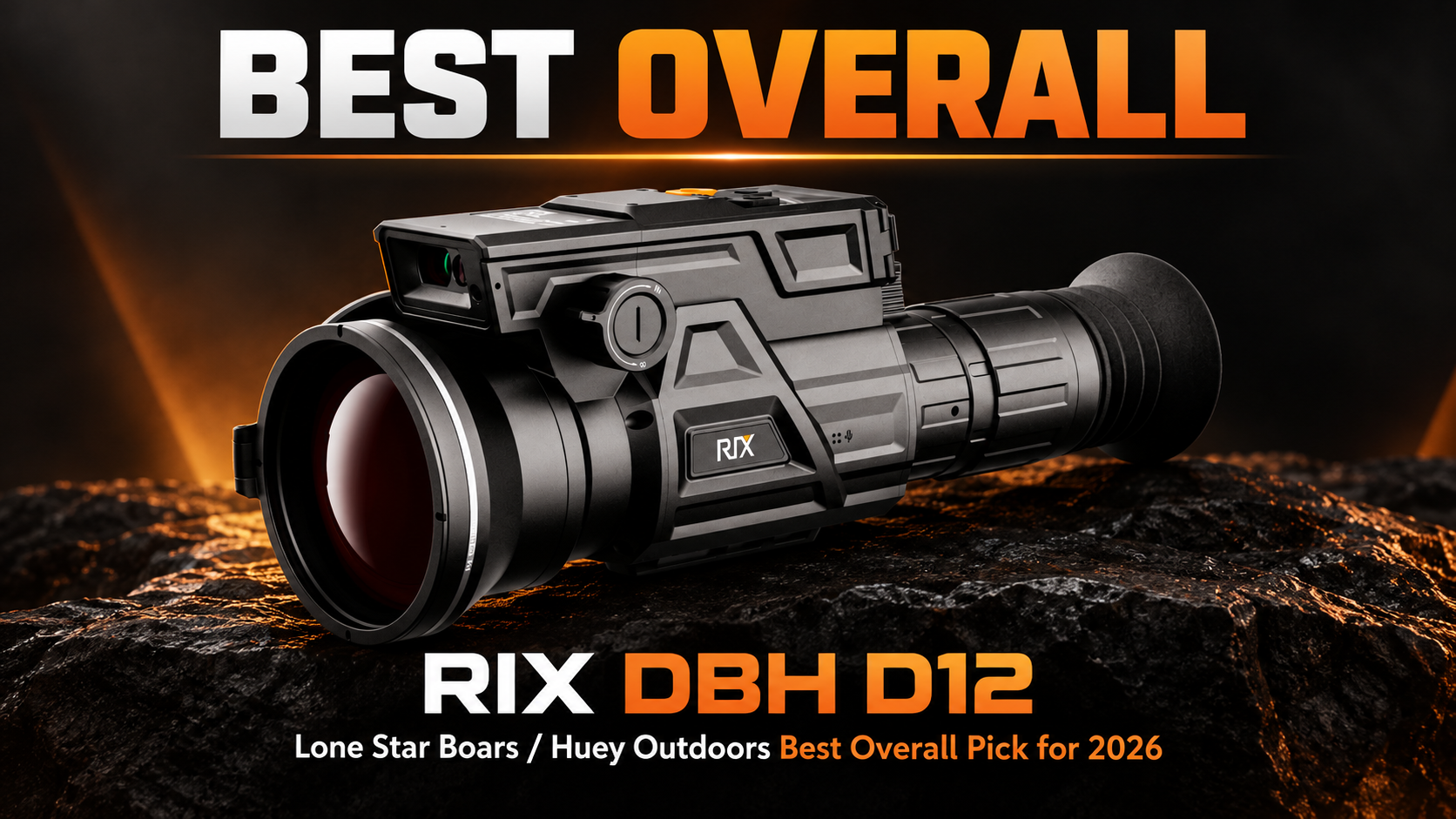
The RIX DBH D12 is my best overall thermal scope for hog hunting in 2026.
After using it in the field and comparing it with multiple 1280 and 640 thermal optics, the DBH D12 produced the best thermal image I have personally seen. The incredible image is not what won me over though, it was just the icing on the cake. The ability to have 3x magnification while having a 60% wider field of view than the 640 version is a game changer making the DBH D12 the do it all scope of 2026.
It also maintained an unusually strong and usable image in high humidity, which is one of the most difficult conditions for any thermal optic.
The D12 combines a 1280×1024, 12-micron sensor with thermal sensitivity rated at 15 mK or better, a 75mm objective lens, 3× base magnification, a built-in 1,312-yard laser rangefinder, and a manufacturer-rated detection distance of up to 4,260 yards. That detection figure should not be confused with positive identification range.
The D12 does more than produce a sharp picture under ideal conditions. Its biggest strength is the amount of usable information it gives the hunter when the environment becomes difficult.
The 1280 sensor provides excellent detail, while the 75mm lens and 3× starting magnification give the scope a strong long-range foundation.
Despite that 3× starting magnification, the D12 still provides an impressive field of view for a distance-oriented thermal. It allows the hunter to see more of the surrounding area than many high-base-magnification long-range scopes.
I would choose the DBH D12 when:
The D12 is expensive, larger, and heavier than a compact thermal scope.
A hunter working primarily around dense brush, narrow shooting lanes, or large groups of hogs at close distance may prefer the wider starting view of the LEAP L12-R, Storm S6R V2, or WAVE ETHOS E6.
The DBH D12 is not automatically the best choice for every hunter. It is the choice for someone who wants the strongest overall thermal image that can perform up close and at range, and is willing to pay for it.
Awards: Best Value 1280, Long-Range Runner-Up
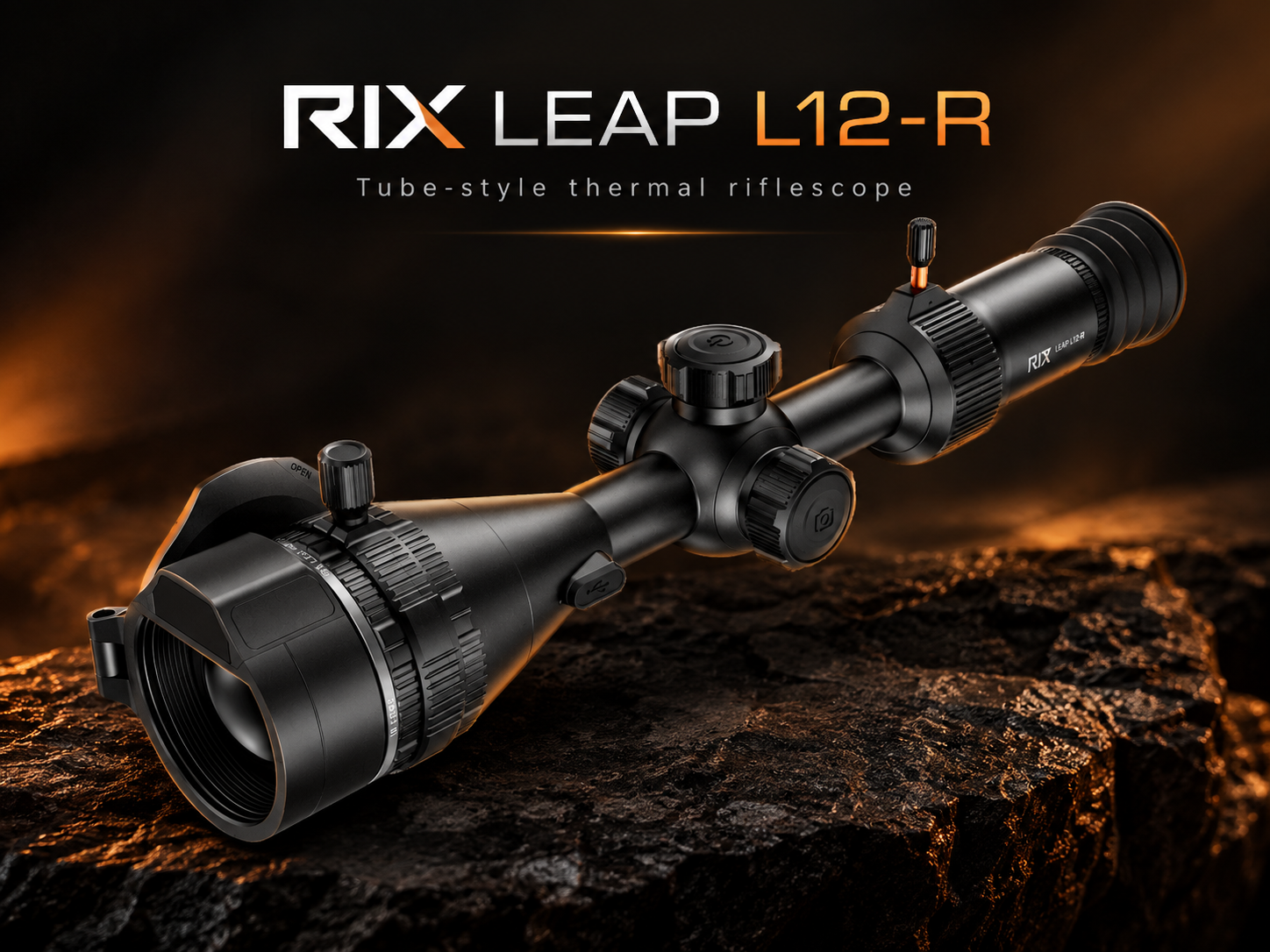
The RIX LEAP L12-R is my best-value 1280 thermal scope.
It combines a 1280×1024 sensor, sub-15 mK thermal sensitivity, a 60mm objective lens, 2×–6× optical zoom, and a 2560×2560 display.
Even though it starts at 2x the ocular zoom gives you the ability to magnify to 6x with very little resolution loss. Then with 1280 you can digitally zoom on top of that 6x and still have a very usable high magnification image.
The L12-R should not simply be thought of as a less expensive DBH D12. The two scopes solve different problems.
The DBH D12 begins at 3× and emphasizes maximum image quality and long-distance performance.
The LEAP L12-R begins at 2× and shows considerably more of the surrounding area.
That wider view becomes extremely useful when:
The L12-R became my summer go-to scope because field of view becomes especially important when grass and vegetation are high.
Its continuous zoom also allows the image to be enlarged smoothly rather than forcing the hunter into large digital-magnification jumps.
My decision between these two is straightforward:
Choose the DBH D12 when you want the best absolute thermal image and maximum long-range performance.
Choose the LEAP L12-R when you want the strongest combination of 1280 image quality, wide field of view, close-to-long-range versatility, and value.
The L12-R is the more forgiving choice for hunters moving between close and long-range conditions.
The DBH D12 remains my choice when maximum image performance is the primary goal.
Awards: Best Value Compact 640, Best Compact Thermal Scope
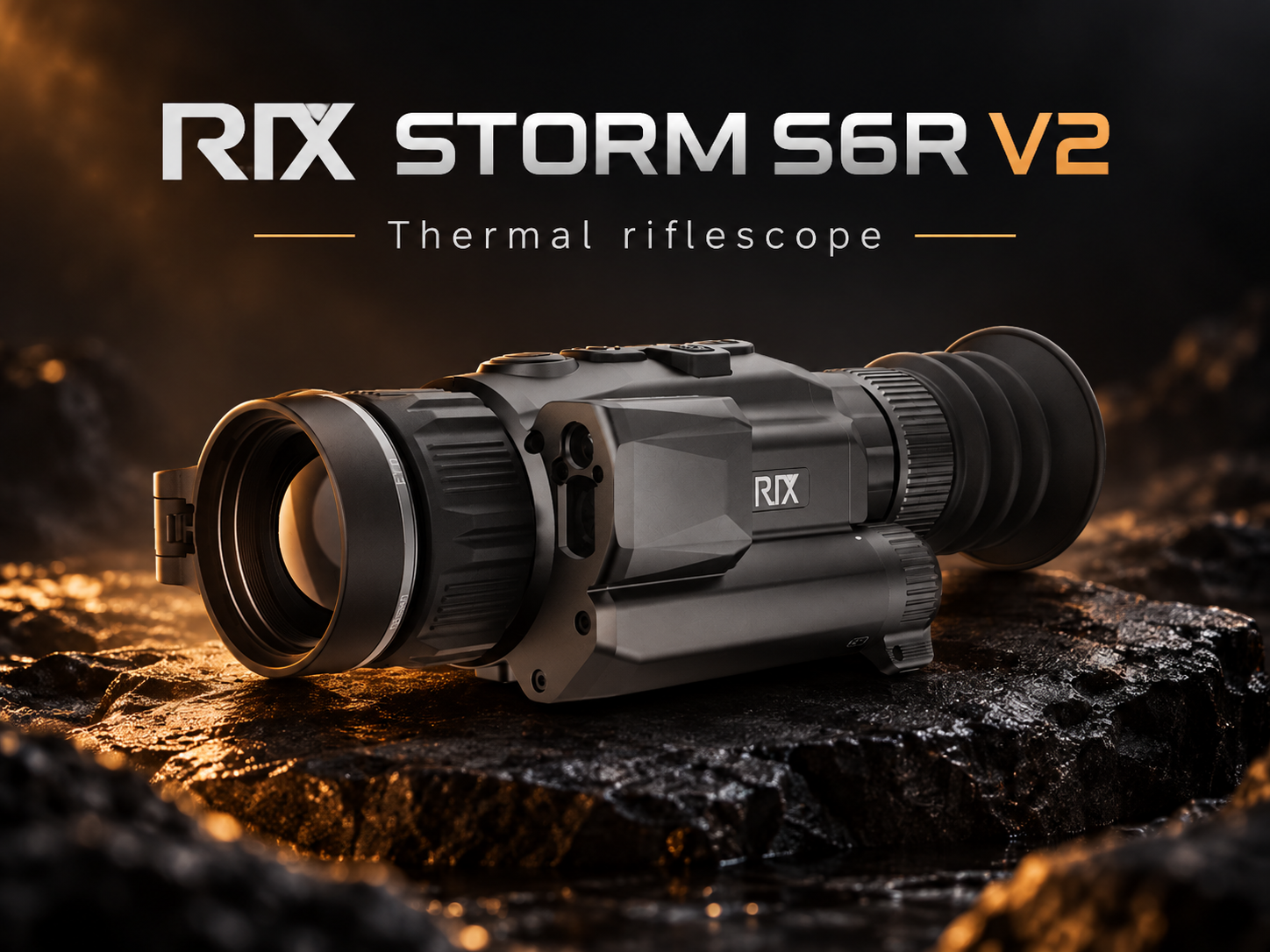
The RIX Storm S6R V2 is my best-value compact 640 and my top compact thermal scope.
It uses a 640×512 sensor with NETD below 15 mK, a 35mm F1.0 objective lens, 2.5× base magnification, a 1920×1080 AMOLED display, and a built-in laser rangefinder rated to 2,187 yards. It also includes onboard ballistic calculation.
The Storm gives hunters a strong 640 image, integrated rangefinding, ballistics, and a compact body without requiring them to move into the size and cost of a premium long-range tube scope.
Its strengths include:
I would choose the Storm S6R V2 when most shots are inside approximately 200 yards, especially around feeders, timber edges, brush, narrow lanes, or groups of hogs.
That does not mean the Storm stops working at 200 yards.
It means its combination of 2.5× base magnification, compact size, and field of view is especially well suited to the fast, practical shooting that commonly happens inside that distance.
The compact 35mm design and lower starting magnification do not provide the same distance-oriented image as the LPR L6R, ATRIS 650 V2, LEAP L12-R, or DBH D12.
A hunter whose normal shots are long and whose terrain is consistently open may prefer a larger objective lens and stronger starting magnification.
For the majority of hunters who want a compact, capable 640 with a rangefinder and ballistics, the Storm S6R V2 is extremely difficult to beat.
Award: Best Full-Featured Long-Range 640
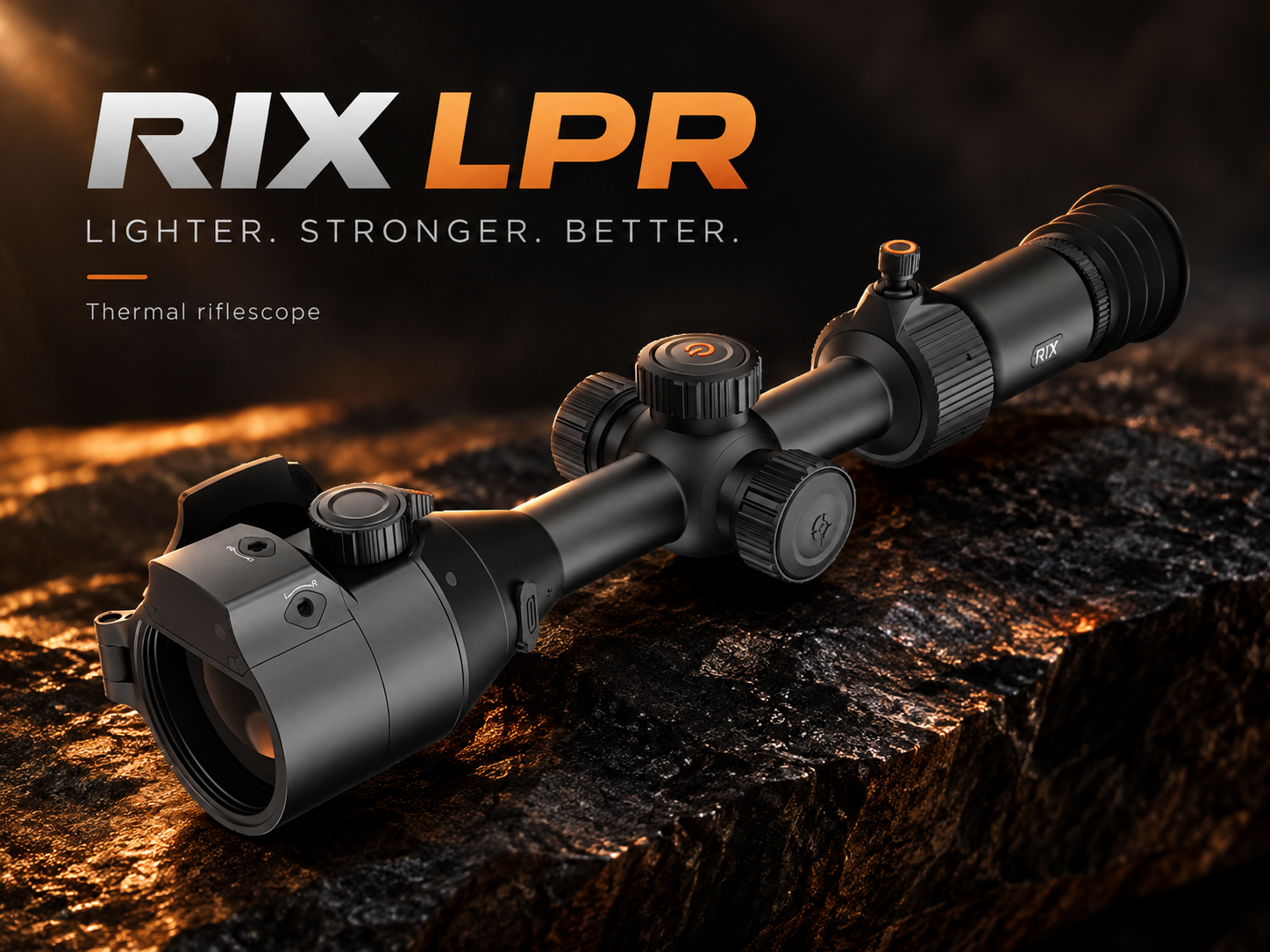
The RIX LPR L6R is my best full-featured long-range 640 thermal scope.
The LPR combines a 640×512, 12-micron sensor with NETD below 12 mK, a 50mm F0.9 objective lens, 3×–9× optical zoom, an integrated laser rangefinder rated to 2,187 yards, and onboard ballistic calculation. RIX also designed the laser-ranging point to be adjustable, allowing it to be aligned more closely with the aiming area.
The LPR has several major advantages over many other 640 thermal scopes.
Continuous optical or ocular zoom: The scope can move smoothly through its magnification range instead of depending entirely on digital enlargement.
Sub-12 mK sensitivity: Its low NETD rating helps the optic distinguish smaller temperature differences when environmental contrast is poor.
Fast F0.9 lens: The large aperture allows the system to collect more thermal energy than a slower lens.
Adjustable LRF alignment: The rangefinding point can be moved closer to the aiming area, reducing the need to range an animal in one part of the display and then relocate it with the reticle.
Integrated ballistics: The LPR provides a more complete all-in-one shooting system than a non-LRF scope. Rix has also built in weather sensors for temperature, humidity, and barometric pressure built into the scope, no other thermals have this capability at the time of this article being writen.
The LPR is the stronger choice when the hunter prioritizes:
Its approximately 46.2-foot field of view at 100 yards is distance-oriented rather than wide.
That view is not as forgiving as the Storm or ETHOS when animals appear very close, but that is the tradeoff for a stronger long-range emphasis.
Awards: Best Value Long-Range 640, Best Long-Range 640 Without an LRF
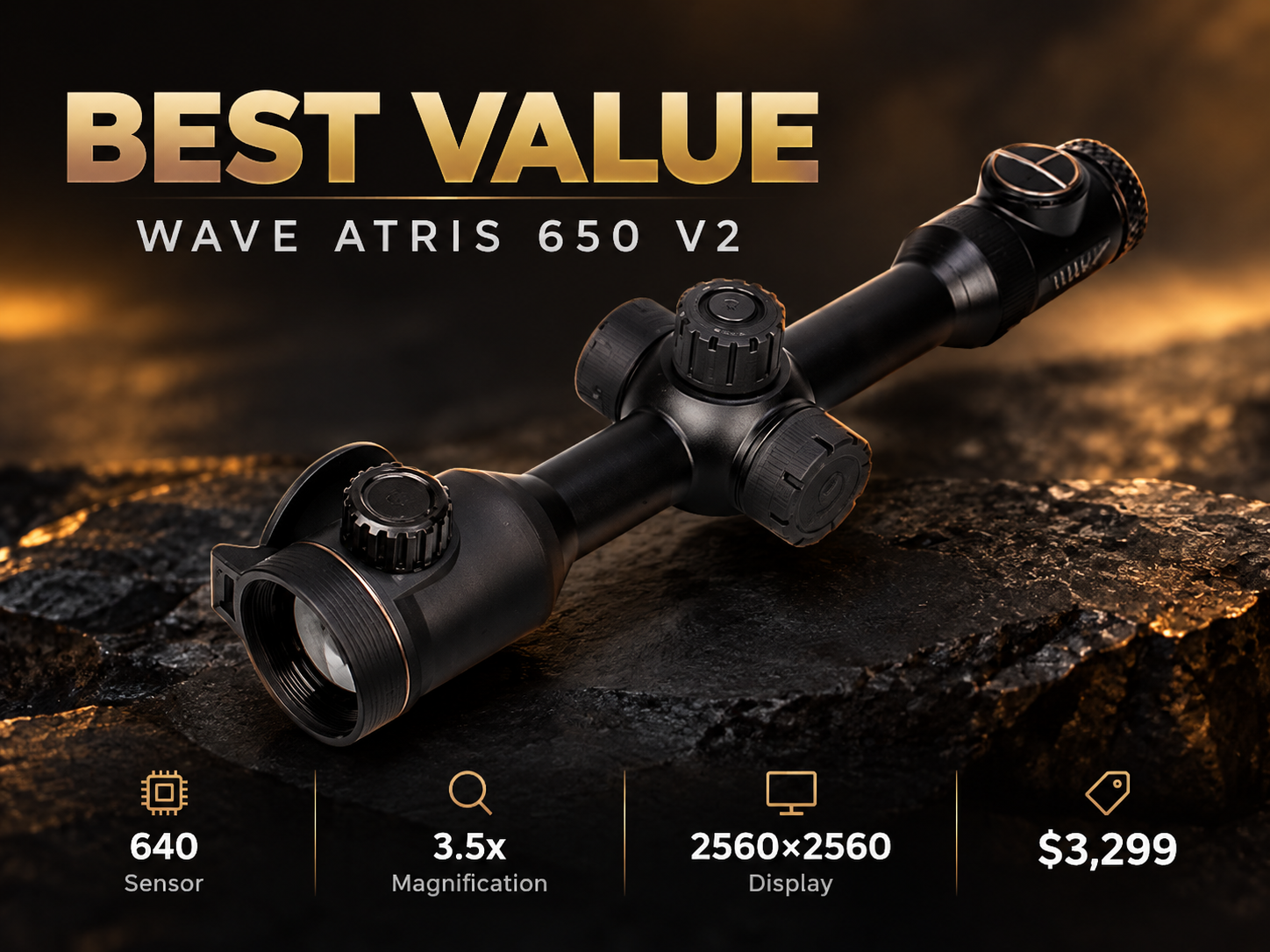
At its current $3,299 price, the WAVE ATRIS 650 V2 may be one of the best bargains in the long-range 640 thermal market.
This is not a stripped-down entry-level thermal.
The ATRIS retains a 640×512, 12-micron sensor, sub-15 mK sensitivity, a large objective lens, 3.5× base magnification, an approximately 47-foot field of view at 100 yards, a high-resolution ViewMax 2560 display, five display-hue options, and six thermal color palettes.
The ATRIS 650 V2 currently sells for $3,299, while the ATRIS 650 LRF V2 sells for $4,699. The non-LRF version therefore saves the buyer $1,400.
The only sacrifices are:
For a hunter who already carries a separate rangefinder, hunts known-distance fields, shoots around feeders with known yardages, or simply does not need onboard ballistics, that can be an excellent trade.
The buyer still gets the core ATRIS thermal-imaging platform.
The ATRIS gives the hunter:
The color palettes and display-hue adjustments are not merely cosmetic.
In my experience, the ATRIS color options can create a more pleasing image and reduce eye strain during long hunting sessions.
A scope may produce a technically sharp image, but if the display becomes uncomfortable after hours behind the eyepiece, the hunter will not use it as effectively.
The ATRIS 650 V2 does not offer the LPR L6R’s continuous ocular zoom, sub-12 mK rating, fast F0.9 lens, adjustable integrated rangefinder, or onboard ranging and ballistic package.
Its approximately 47-foot field of view at 100 yards is also effectively the same as the LPR’s approximately 46.2-foot view.
The one-foot difference is meaningless in actual hunting and should not influence the decision.
The ATRIS does not beat the LPR feature-for-feature.
It competes through price, image comfort, color filters, and the fact that it retains a serious 3.5× long-range 640 image for $3,299.
The LPR and ATRIS are both serious long-range 640 thermal scopes, but they serve different buyers.
The field of view between the two is essentially tied.
The real decision is full-featured performance versus price and viewing comfort.
The LPR is the stronger overall scope.
The ATRIS 650 V2 is the long-range value champion.
Award: Best Wide-Field Tube-Style 640 Alternative
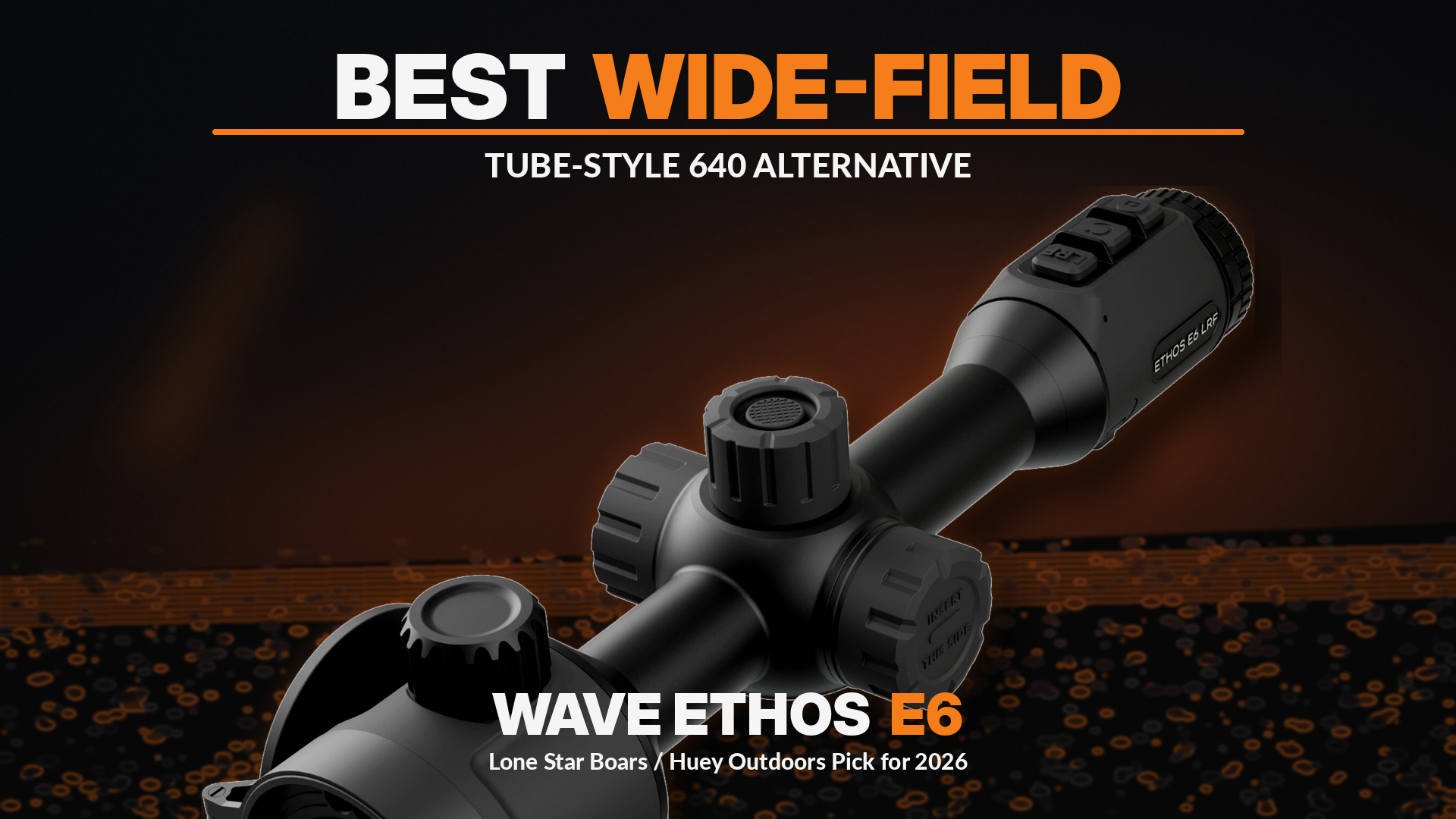
The WAVE ETHOS E6 is the alternative for hunters who like the wide-view advantages of the Storm but prefer the mounting position, appearance, and handling of a traditional tube-style scope.
The ETHOS E6 uses a 640×512 sensor, a 44mm objective lens, 2.5× starting magnification, an integrated laser rangefinder, and automatic ballistics. Its manufacturer-listed field of view is 670 feet at 1,000 yards, or approximately 67 feet at 100 yards.
The ETHOS is well suited to hunters who want:
The ETHOS does not have the same long-range emphasis as the LPR or ATRIS 650.
Its strength is flexibility.
It is the more forgiving choice around feeders, brush, moving animals, multiple hogs, and closer shooting situations.
RIX dominates several categories in this guide because, in my Texas field testing, RIX thermal optics have consistently produced the strongest and most usable images in high heat and humidity among the brands I have personally tested.
That does not mean every RIX scope is automatically the best choice for every hunter.
The ATRIS may be preferred by someone who values its price, display-hue options, and comfortable color filters.
The ETHOS may be preferred by a hunter who wants a traditional tube design with a genuinely wide field of view.
However, I am not going to force another brand into a winning position simply to make the list look more balanced.
The recommendations should reflect what actually works in the field.
Humidity reduces thermal contrast.
On a cool, dry night, a warm animal may stand out sharply from the background.
On a hot, humid Texas night, the temperature difference between the animal, ground, vegetation, and surrounding air can become much smaller.
That is when thermal sensitivity, lens quality, image processing, manual image adjustment, and weather modes become especially important.
In my own field testing, RIX scopes have consistently handled those difficult conditions better than the rest.
The DBH D12 has been the standout, but the LEAP L12-R, LPR L6R, and Storm S6R V2 have also produced strong, usable images when humidity made other thermals struggle.
A low NETD rating helps, but the number alone does not determine the final image.
The complete system matters:
The differences between 384, 640, and 1280 thermal sensors deserve a complete article of their own.
The basic differences are:
A quality 384 can be a practical entry point for hunters working at closer distances or with a tighter budget.
The right 384 can still be extremely effective when its objective lens, base magnification, and field of view match the terrain. These work best for hunters watching a static area like a feeder.
A quality 640 is currently the sweet spot for many serious hog and predator hunters.
It generally provides more detail, stronger target separation, and more usable digital magnification than a typical 384 without moving into premium 1280 pricing.
A 1280 sensor provides substantially more source information and can preserve more useful detail as magnification increases.
It is most valuable to hunters who demand premium image quality, wide high-resolution views, or stronger long-range identification.
Sensor resolution is only one part of the equation.
Lens size, F-number, NETD, display resolution, base magnification, field of view, image processing, and environmental conditions all affect what the hunter actually sees.
Detection range is the distance at which a thermal optic can show that a heat source is present.
It does not mean the hunter can determine exactly what that heat source is.
Identification range is the distance at which the hunter can confidently determine whether the heat source is a hog, coyote, deer, calf, person, or something else.
Identification range is affected by:
Time behind a thermal optic increases practical identification range.
An experienced thermal hunter develops pattern recognition.
Body shape, gait, ear position, posture, movement, behavior, and how an animal interacts with the surrounding group can all help identify it.
I may be able to identify a target much farther away than a new thermal user looking through the exact same scope.
That is not because the scope changed.
It is because experience changes what the hunter recognizes.
Detection should never be confused with positive target identification. Never take a shot based only on the presence of a heat source.
You want the best overall thermal image I have personally experienced and your priorities are premium image quality, difficult humidity, and maximum long-range performance.
You want 1280 image quality, a wide 2× starting view, smooth zoom, and the strongest overall value in the premium 1280 class.
You want a compact, lightweight, wide-view 640 with integrated ranging and ballistics, and most of your shots take place inside approximately 200 yards.
You want the strongest complete long-range 640 package, including sub-12 mK sensitivity, ocular zoom, an F0.9 lens, adjustable LRF alignment, and onboard ballistics.
You want a 3.5× long-range 640, a high-resolution display, comfortable color filters, and outstanding performance for $3,299—and you can live without an integrated laser rangefinder.
You want a tube-style 640 with a genuinely wide field of view, integrated rangefinding, automatic ballistics, and better close-to-medium-range versatility.
The RIX DBH D12 is the best overall thermal scope in this guide when image quality and long-range performance are the priorities.
The RIX LEAP L12-R is the strongest value in the 1280 class and may be the better real-world choice for hunters who need a wider starting field of view.
The RIX Storm S6R V2 is the best-value compact 640 for hunters who prioritize field of view, fast target acquisition, integrated ranging, and practical shooting inside approximately 200 yards.
The RIX LPR L6R is my top full-featured long-range 640 for hunters who prioritize thermal sensitivity, optical or ocular zoom, an F0.9 lens, adjustable LRF alignment, and onboard ballistics.
The WAVE ATRIS 650 V2 is the best-value long-range 640 in this guide. At $3,299, it provides a 640 sensor, 3.5× base magnification, a premium high-resolution display, and color filters that can make extended viewing more comfortable. The buyer gives up the integrated rangefinder and ballistics found in the $4,699 LRF version but saves $1,400.
The WAVE ETHOS E6 is the best wide-field tube-style alternative for hunters who want a traditional scope design without giving up close-to-medium-distance versatility.
The best thermal scope is not simply the most expensive one.
It is the scope whose field of view, base magnification, physical design, image quality, controls, and features best match the way and place you actually hunt.
Have questions about which scope is right for your terrain and typical shooting distance? Call Huey Outdoors at 817-668-1001 and tell us how you hunt. We use these optics in the field and will help you choose the model that fits your needs rather than simply pushing the most expensive scope.
Based on my field use, the RIX DBH D12 is the best overall thermal scope in this guide.
It combines premium 1280 resolution, a large 75mm objective lens, strong long-range performance, and the best thermal image I have personally used.
The RIX Storm S6R V2 is my best-value compact 640.
It provides strong 640-resolution performance, a compact body, a wide starting view, integrated rangefinding, ballistics, and a high-resolution display.
The WAVE ATRIS 650 V2 is my best-value long-range 640.
At $3,299, it provides a 640 sensor, 3.5× base magnification, a high-resolution display, and multiple color-filter options.
The major tradeoff is the lack of an integrated laser rangefinder and automatic ballistic solution.
The RIX LPR L6R is my best full-featured long-range 640.
Its advantages include sub-12 mK thermal sensitivity, continuous optical or ocular zoom, an F0.9 objective lens, adjustable LRF alignment, and onboard ballistics.
Choose the LPR when thermal sensitivity, ocular zoom, integrated ranging, and the strongest complete feature package are the priorities.
Choose the ATRIS when the lower $3,299 price and comfortable display-color options matter more than having an integrated LRF.
Their fields of view are effectively the same.
Yes.
A quality 640 is more than capable for most hog-hunting situations.
The appropriate objective lens, base magnification, field of view, thermal sensitivity, and image processing are often more important than simply moving to a 1280 sensor.
It can be for hunters who want maximum detail, more usable magnification, wider high-resolution views, or premium long-range target identification.
A 1280 is not necessary for every hunter, and a well-matched 640 may provide better value for normal hunting distances.
No, but an integrated rangefinder can be extremely useful when shooting distances change regularly or when precise distance is difficult to estimate in darkness.
A non-LRF scope such as the ATRIS 650 V2 can still be an excellent choice for hunters who carry a separate rangefinder, know the distances around their hunting property, or do not need an automatic ballistic solution.
Among the brands I have personally used in Texas humidity, RIX has consistently provided the strongest overall performance.
The DBH D12 has been the standout, followed by strong results from the LEAP L12-R, LPR L6R, and Storm S6R V2.
What base magnification is best for hog hunting?
Lower base magnification is generally better for feeders, brush, and groups of moving hogs because it gives you a wider field of view. Higher base magnification is better suited to longer shots in open country.
Is thermal better than night vision for hog hunting?
For night hunting, night vision cannot compete with thermal for locating animals. Thermal detects heat rather than reflected light, so it works in complete darkness and makes animals stand out even when natural camouflage would make them difficult to see with night vision. Thermal can also perform far better than night vision through many conditions involving light dust, smoke, haze, and some fog.
The main limitation is that thermal cannot see through ordinary glass. If you are driving a vehicle or scanning through a window from inside a building, night vision has the advantage because it can see through glass while thermal generally cannot.