

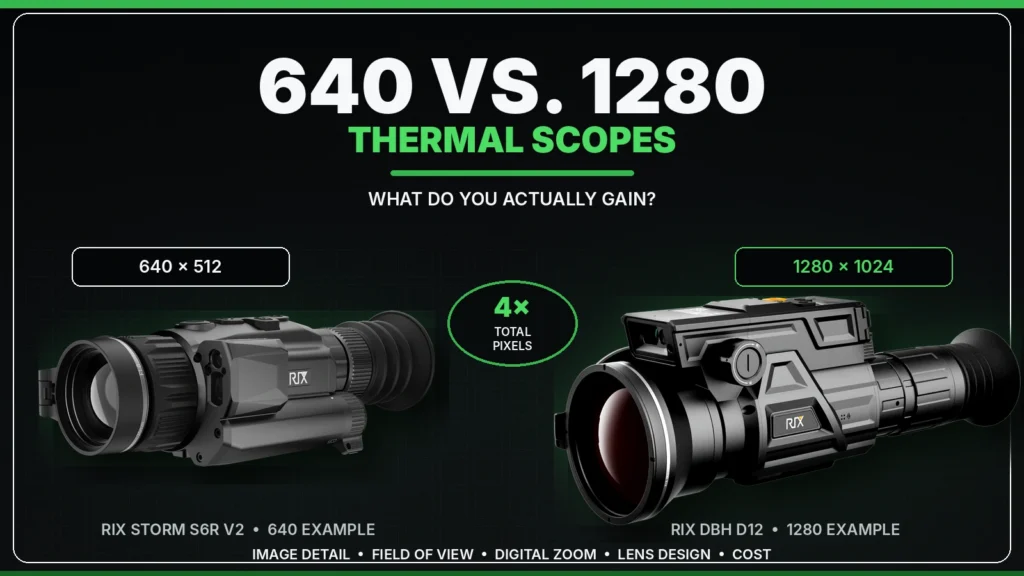
When hunters compare a 640 thermal scope with a 1280 thermal scope, the first thing everyone talks about is resolution.
That makes sense. A 1280×1024 thermal sensor has twice as many pixels from side to side and twice as many pixels from top to bottom as a 640×512 sensor.
That means a 1280 sensor contains four times as many total detector pixels:
But four times the pixels does not automatically mean four times the image quality.
Lens quality, focal length, objective diameter, f-number, thermal sensitivity, pixel pitch, display resolution, image-processing algorithms, focus quality, humidity, and other environmental conditions all affect the final image.
For this comparison, I am going to assume we are comparing two equally well-designed thermal scopes with similar sensor quality, thermal sensitivity, displays, and image processing.
Under those conditions, a 1280 thermal provides several major advantages over a 640 thermal—and the sharper image is only part of the story.
I enjoy the increased image detail of a good 1280 thermal. A properly designed 1280 can produce an exceptionally clean and natural-looking thermal image.
But for me, the improved image is almost icing on the cake.
The greatest practical advantage is the ability to combine:
With most thermal scopes, increasing magnification costs you field of view. A wide field of view normally requires lower magnification.
A properly designed 1280 thermal can give you more of both.
You can have the useful magnification normally associated with a longer lens while retaining a field of view closer to what you would expect from a lower-magnification 640 thermal.
That is the real advantage to me.
A 1280 sensor does not automatically guarantee a better hunting image than every 640 sensor.
Sensor resolution determines how many individual thermal measurement points are available, but the final image depends on the complete optical and electronic system.
Important factors include:
NETD describes how small a temperature difference the system can distinguish. A lower NETD number generally means the system can separate smaller temperature differences.
That becomes especially important when an animal and the surrounding ground, vegetation, or air are close to the same temperature.
The display also affects what the hunter sees. A high-resolution display can present the sensor image more clearly, while good processing can improve contrast, reduce noise, and make edges easier to recognize.
However, neither the display nor the software can create genuine target information that the sensor and lens never captured.
That is why an excellent 640 thermal can outperform a poorly designed 1280 thermal.
Resolution is a major advantage, but it must be supported by the lens, sensor sensitivity, display, processing, and overall design.
A lower f-number generally allows more infrared energy to reach the thermal detector. That can improve image sensitivity and help the scope distinguish small temperature differences, especially in humidity, haze, or other difficult thermal conditions.
However, that additional sensitivity comes with a tradeoff: depth of field.
Depth of field is the range of distances that remain acceptably sharp without adjusting the focus. The same basic principle applies to a thermal lens as it does to a traditional camera lens.
With a regular camera, a photograph taken at f/8 may keep both the subject and much of the background in focus. At f/2.8, the subject may remain sharp while the background becomes blurry.
A very low f-number thermal lens can behave in a similar way. It may produce an exceptionally sharp image at the exact distance where it is focused, but animals closer or farther away may quickly become soft or blurry.
The exact depth of field also depends on:
Longer focal-length lenses, such as 60mm or 75mm thermal lenses, generally have less depth of field than shorter lenses under similar conditions.
This can be more important in the field than it appears on a specification sheet.
I have used thermal scopes that produced an extremely sharp image, but only within a fairly narrow focus range. The target and an area approximately 20 yards in front of and behind it might remain sharp. If the animal moved substantially closer or farther away, I had to adjust the objective focus again.
I have also used fixed-focus thermal scopes that remained acceptably sharp from approximately 25 yards to infinity. With those optics, I never had to stop tracking a moving animal to adjust the focus.
That is a major advantage when shooting hogs or predators that are constantly changing distance.
A razor-sharp image at one exact distance can be impressive, but that advantage can disappear quickly if the animal moves and the hunter must stop to refocus the scope.
A fixed-focus thermal scope is normally designed so that a broad range of distances remains acceptably sharp.
The advantage is speed and simplicity. The hunter can follow an animal as it moves closer, farther away, or across a field without touching the objective focus.
The tradeoff is that a fixed-focus optic may not produce the same maximum sharpness at one exact distance as a carefully focused manual-focus lens.
Neither design is automatically better.
A very low f-number and manual focus may be the better choice when maximum sensitivity and the sharpest possible image are the priorities.
A broader depth of field or fixed-focus design may be better when:
The lowest f-number does not automatically make a thermal scope the best hunting optic.
The best design balances infrared transmission, thermal sensitivity, image sharpness, depth of field, focal length, sensor resolution, and how the scope will actually be used in the field.
One complication in comparing thermal scopes is that manufacturers do not always describe their lenses in exactly the same way.
A specification such as 50mm, 60mm, or 75mm often refers to the lens’s focal length. Some manufacturers also publish the physical diameter of the objective lens.
Those measurements affect different parts of the system.
Focal length largely controls image scale, base magnification, and field of view.
A longer focal length makes a distant target occupy more pixels on the sensor. That can improve long-range detection and identification because the target appears larger in the captured image.
The normal tradeoff is a narrower field of view.
Objective diameter or clear aperture affects how much infrared energy the lens can collect and transmit toward the sensor.
A wider usable aperture can deliver more infrared information to the detector, assuming the lens material, coatings, sensor, and other parts of the system are also good.
For example, the WAVE ATRIS 650 V2 is listed with a 50mm focal length and a 56mm objective diameter. Those numbers are not contradictory. One describes focal length, while the other describes the physical size of the objective.
What ultimately matters optically is the usable clear aperture inside the lens assembly, not merely the outside diameter of the housing. However, the larger physical objective helps illustrate why focal length and objective diameter should not be treated as the same measurement.
I often explain lens size using a garden hose and a fire hose.
A garden hose can move only so much water. If a house catches on fire and firefighters arrive with a much larger hose, they can move far more water than you can with the small hose used to water your yard.
That is not a perfect scientific description of thermal optics, but it helps illustrate the basic idea.
A larger usable objective aperture can collect and transmit more infrared energy than a smaller aperture.
The thermal lens is not sucking heat into the scope. It is collecting infrared radiation from the scene and focusing that energy onto the detector.
A larger and faster lens can provide the detector with more infrared information, but it must still be matched properly with the focal length, sensor size, thermal sensitivity, and image-processing system.
The size difference between a 50mm and 75mm thermal objective can be dramatic.
In the photograph below, the RIX DBH D12’s 75mm objective is sitting beside the RIX LPR L6R’s 50mm objective.
The D12 lens is wider than the entire LPR scope body and rangefinder assembly.
That larger lens is not simply there for appearance.
It is part of a complete optical system designed to provide greater image scale, longer-range performance, and strong image quality. At the same time, the larger 1280 sensor helps preserve a much wider field of view than a smaller sensor could provide with the same focal length.
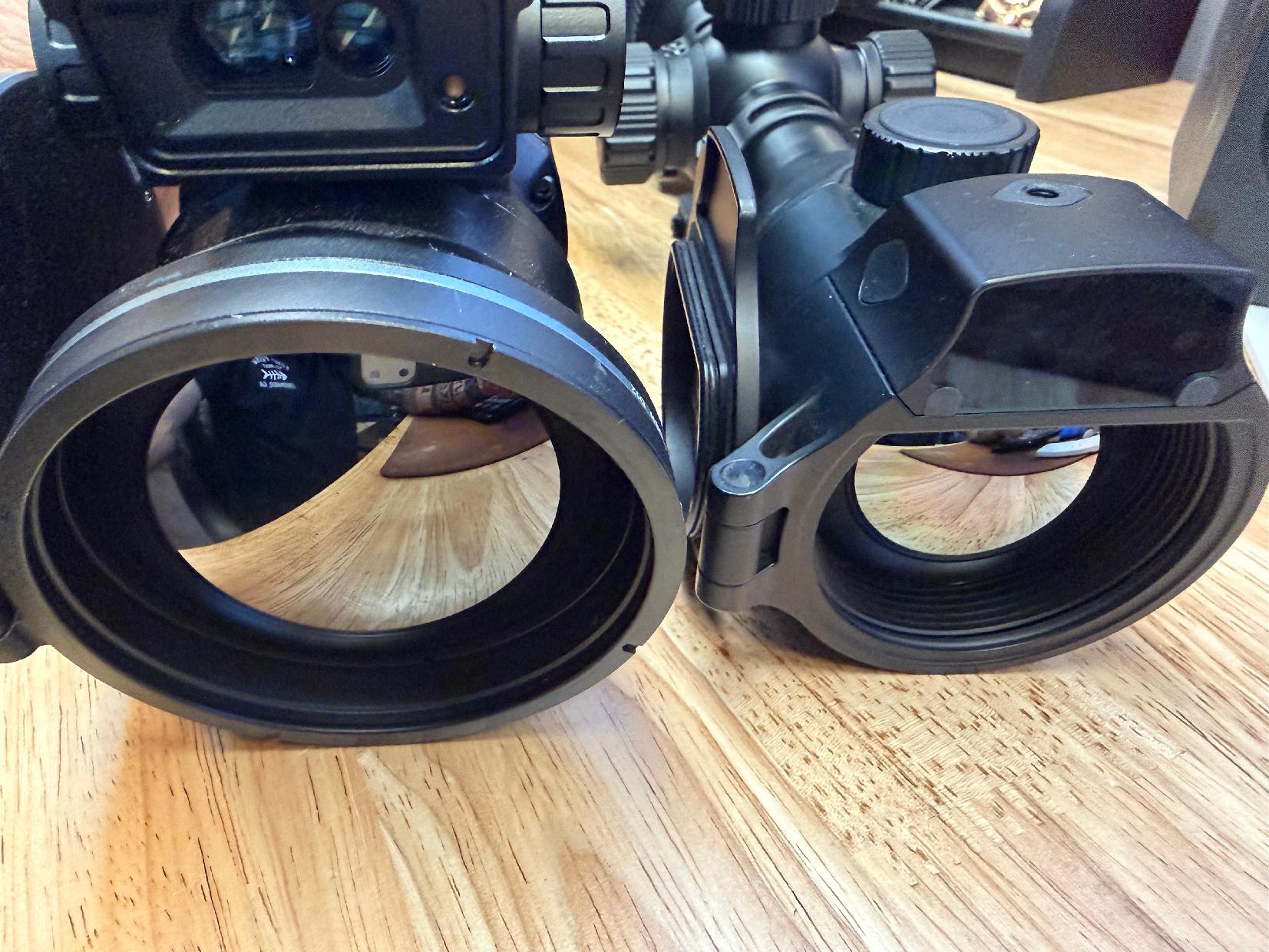
RIX DBH D12 75mm objective lens beside the RIX LPR L6R 50mm objective. The D12 lens is wider than the entire LPR body and rangefinder assembly.
The physical size of the sensor has a major effect on field of view and apparent base magnification.
As a simplified example, consider several comparable 12-micron sensors using approximately the same 50mm focal-length lens and similar display and eyepiece geometry.
A common result could be approximately:
Those are not universal numbers. Exact magnification varies between manufacturers, displays, eyepieces, and optical designs.
The point is that when you increase the width of the sensor while keeping the same focal length, the system captures a wider portion of the scene.
That produces a wider field of view and lower apparent magnification.
This is why many 1280 thermal scopes use longer focal-length lenses such as 60mm or 75mm instead of the smaller lenses commonly used on lower-resolution scopes.
The longer focal length restores useful magnification.
The larger 1280 sensor helps preserve a wide field of view.
The RIX DBH D12 uses a 1280×1024 sensor, a 75mm objective lens, and 3× base magnification.
The 640-resolution RIX DBH D6 uses a smaller 60mm lens and also begins at approximately 3×.
The larger 75mm lens on the D12 restores the useful starting magnification while the much larger 1280 sensor provides a dramatically wider field of view.
In my comparison, the DBH D12 provides approximately 60% more horizontal and vertical field of view than the DBH D6 while giving the hunter the same 3× base magnification.
That is a major real-world advantage.
You are no longer forced to choose between magnification and field of view.
You get useful long-range magnification while still seeing much more of the area around the target.
That wider view matters when:
That is what I mean when I say a good 1280 thermal can give you the best of both worlds.
Read Todd Huey’s complete RIX DBH D12 field-tested review for his five-day ranch comparison and high-humidity observations.
Digital zoom creates magnification by cutting away the outside portion of the sensor image and enlarging the smaller center section to fill the display.
When you move from 1× to 2× digital zoom, the scope uses approximately half the original image width and half the original image height.
That is how the image is made to appear twice as large.
The tradeoff is resolution.
Cutting each dimension in half leaves approximately one-quarter of the original total sensor pixels supplying real image information.
For example:
| Sensor | Native Image | 2× Digital Zoom | 4× Digital Zoom | 8× Digital Zoom |
|---|---|---|---|---|
| 1280×1024 | 1280×1024 | About 640×512 | About 320×256 | About 160×128 |
| 640×512 | 640×512 | About 320×256 | About 160×128 | About 80×64 |
The scope enlarges that cropped portion to fit the display. Image processing may make it appear smoother or sharper, but digital zoom cannot create target information that was not captured by the remaining sensor pixels.
This is one of the biggest practical advantages of 1280.
At approximately 2× digital zoom, a 1280×1024 sensor still has about 640×512 original sensor pixels contributing to the image.
A native 640×512 sensor at the same 2× digital-zoom step has already been reduced to approximately 320×256 original pixels.
That gives the 1280 scope much more room to magnify before the image begins losing useful detail.
A 1280 sensor is especially well suited to scopes that use adjustable ocular magnification in addition to digital zoom.
The RIX LEAP series is a good example.
Ocular zoom enlarges the image the hunter sees through the eyepiece without immediately cropping away sensor pixels in the same way digital zoom does.
It does not create new thermal detail, but it allows the hunter to enlarge the displayed image while retaining the sensor information that has already been captured.
That makes the combination of the following extremely effective:
With a 1280 sensor, the scope begins with an enormous amount of usable information.
The hunter can enlarge the displayed image through the ocular system and still have plenty of sensor resolution left when additional digital magnification is needed.
This is why I believe 1280 is almost perfect for the LEAP-style design.
Even when heavily magnified, the optic can retain far more usable information than a lower-resolution thermal that began with fewer pixels.
See how that combination performs in the field in Todd’s RIX LEAP L12-R field review.
A 1280 sensor by itself does not automatically guarantee a longer detection range.
Detection and identification performance depend on the complete system:
However, many 1280 thermal scopes are paired with larger and longer lenses because the larger sensor can support them while retaining a usable field of view.
That combination can provide:
The sensor and lens must be evaluated together.
Manufacturers often advertise extremely long detection ranges.
Detection simply means the optic can recognize that a heat source is present.
That does not necessarily mean the hunter can tell whether the heat source is a hog, calf, deer, coyote, person, or another animal.
Identification requires enough detail to determine what the target actually is.
A 1280 sensor can place more pixels on a distant target, especially when paired with a suitable longer focal-length lens. That can provide a major advantage for positive identification.
For responsible hunting, identification distance is far more important than the maximum advertised detection distance.
No.
A poorly designed 1280 thermal can be outperformed by an excellent 640 thermal.
A strong 640 scope with:
may produce a more useful hunting image than a lower-quality 1280 device.
Resolution is only one part of the system.
That is why I do not recommend choosing a thermal scope from the sensor specification alone.
The main disadvantage is cost.
A quality 1280 sensor is considerably more expensive than a 640 sensor.
High-end 1280 scopes are also normally paired with:
There can also be some additional weight because of the larger lens and body.
Manufacturers may list somewhat shorter battery life because the larger sensor, display, and processing system can require more power.
In my own use, battery life has not been a significant problem.
The added size and weight have also not been enough to outweigh the benefits.
For me, the performance gain is well worth the tradeoff.
A good 640 thermal is still more than capable for most hog and predator hunting.
A 640 is often the better choice for someone who wants:
There are excellent 640 scopes that can handle the vast majority of real-world hunting situations.
A quality 640 is not a low-end thermal. It is a serious hunting tool.
Looking for a full-featured long-range 640 example? Read Todd Huey’s RIX LPR L6R field-tested review, including the mounted-weight comparison, optical eyepiece magnification, adjustable rangefinder, high-humidity performance, and real hunting results.
A 1280 makes the most sense for someone who wants:
The largest advantage is not simply that the 1280 image looks sharper.
It is the flexibility that comes from having four times the sensor pixels available.
| Feature | Quality 640 Thermal | Quality 1280 Thermal |
|---|---|---|
| Native sensor pixels | 640×512 | 1280×1024 |
| Total pixel count | 327,680 | 1,310,720 |
| Image detail | Excellent | Exceptional |
| Digital zoom reserve | Good | Much greater |
| Field of view at similar magnification | Narrower | Potentially much wider |
| Long-range identification | Strong | Greater potential |
| Size and weight | Usually smaller | Often larger |
| Battery demand | Usually lower | May be somewhat higher |
| Cost | More affordable | Significantly more expensive |
| Best fit | Most hunters | Hunters wanting premium performance |
For Todd’s current recommendations across both resolutions, see the Best Thermal Scopes for Hog Hunting in 2026: Field-Tested Picks.
A 1280 thermal gives you four times as many detector pixels as a comparable 640 thermal.
The extra resolution improves image detail, but that is not the biggest advantage to me.
The real advantage is being able to combine:
A good 1280 thermal allows you to have useful magnification without feeling like you are looking through a tunnel.
Then, when you need additional magnification, you have far more resolution available before digital zoom seriously damages the image.
The disadvantages are primarily price and a small amount of additional size and weight.
For me, those are worthwhile tradeoffs.
A good 640 thermal remains an excellent choice for most hunters and will handle the overwhelming majority of real-world hog and predator hunting situations.
But when image quality, field of view, magnification, and long-range performance all matter—and the budget allows it—a properly designed 1280 thermal offers advantages that go far beyond simply producing a prettier picture.