

I’ve been using thermal optics for a long time, and one thing I’ve learned is that the specification sheet does not always tell you which scope you are actually going to enjoy hunting with.
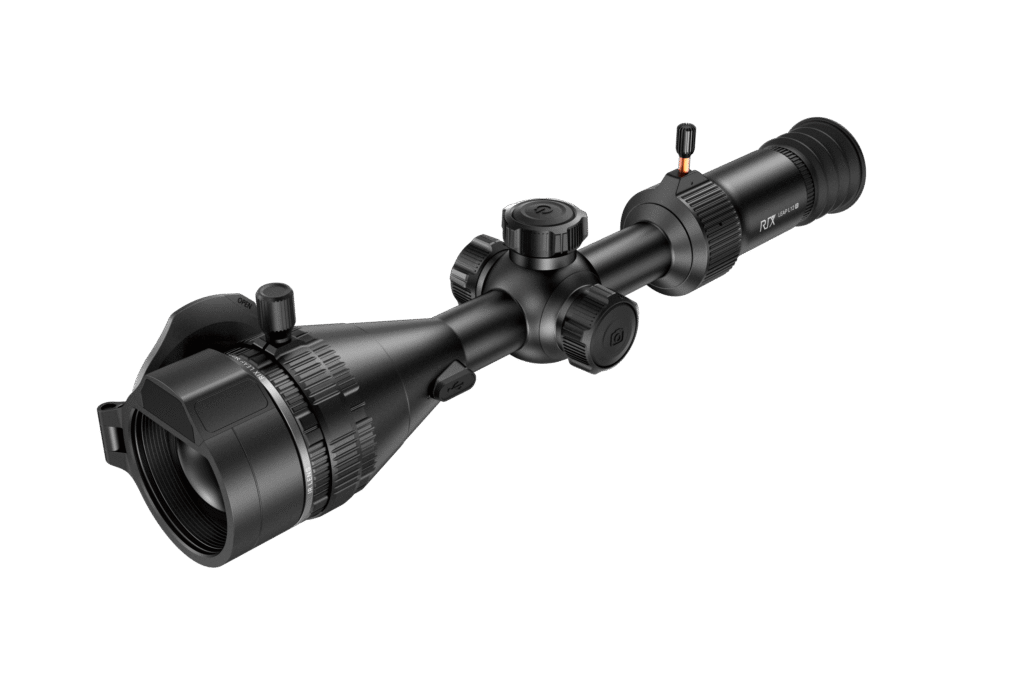
The RIX LEAP L12R is a perfect example.
On paper, the number everybody notices first is the 1280×1024 sensor. And yes, the image is excellent.
But that is not what made me keep grabbing this scope all summer.
What really won me over was the field of view.
Here in Texas, summer hunting is a completely different game than winter. The grass gets tall, crops come up, tree lines thicken and a lot of the long sight lines you have during the colder months disappear.
The same thing applies when I hunt thicker country like the piney woods of East Texas or heavy mesquite in West Texas.
Shots generally get closer.
Sometimes a lot closer.
When a group of hogs suddenly appears at 30 or 40 yards, having too much magnification can become a problem very quickly.
That is where the LEAP L12R really started to separate itself for me.
The L12R starts at 2x magnification with an extremely wide field of view.
RIX lists the field of view at 14.6° × 11.7°, which works out to roughly 78 feet horizontally at 100 yards.
That is a big viewing window.
When I’m hunting thick vegetation, I want to see what is happening around the animal.
I don’t want to find one hog and lose the rest of the group because the scope is too tight.
I don’t want to fight to find a running animal.
And I definitely don’t want a scope that is great at 250 yards but miserable at 25.
The L12R gives me room to work.
That wide 2x view is the biggest reason it became my preferred thermal scope during the summer.
The nice thing about the L12R is that the wide starting view does not make it a short-range-only scope.
When the terrain opens up, there is still plenty of magnification available.
That is where the L12R’s ocular zoom becomes one of my favorite features.
RIX markets the system as optical zoom. I describe it as ocular zoom because the rear adjustment enlarges the thermal image you are viewing through the eyepiece rather than working like a conventional variable day scope where moving objective lens groups change the focal length.
The practical result is what matters to me.
Using the rear lever, I can smoothly move from around 2x to 6x ocular magnification instead of immediately jumping into large digital-zoom steps.
If I only need a little more magnification, I only use a little more.
Then if I still need additional reach, digital magnification is available on top of that.
For actual hunting, I find that much more useful than simply having a 2x, 4x, 8x sequence and being forced to make a big jump every time I want a closer look.
The L12R uses a 1280×1024, 12-micron thermal sensor.
That gives you four times the total detector pixels of a 640×512 sensor.
That does not mean you automatically see four times the detail. Lens quality, processing, thermal sensitivity, weather, focus and the display all contribute to the final image.
But having that much resolution available gives the scope considerably more image information to work with as magnification increases.
That is one of the places where 1280 really starts to make sense.
You begin with a wide 2x viewing window and still have enough resolution available to increase magnification when the situation changes.
That combination is what makes the L12R so versatile.
I get asked this a lot.
My answer is simple.
If you ask me which RIX scope produces the best absolute thermal image I have personally seen, I’m still choosing the DBH D12.
The D12 has a 75mm objective lens, starts at 3x, and to my eye it produces the better overall image.
But that doesn’t mean I automatically choose the D12 every time I leave the house.
The D12 gives me the better absolute image.
The L12R gives me the wider 2x view.
Those are two different advantages.
If I’m hunting a big open ranch and expect longer shots, I may lean toward the D12.
If I’m going into thicker country where hogs may suddenly appear close, I really like the L12R.
That is why I don’t think of the L12R as simply a cheaper D12.
It is a different tool.
Humidity is another thing I pay a lot of attention to.
A lot of thermal scopes look great on a cool, dry night.
The real test for me is what happens when the weather gets ugly.
Humidity can absolutely destroy a thermal image.
The L12R has performed very well for me under those conditions.
Across the RIX products I have used, their image tends to hold together very well as humidity increases.
I’m not claiming that I conducted a laboratory humidity test.
I didn’t.
I am talking about what I see while actually hunting.
That is the kind of testing that matters to me.
If two scopes have nearly identical numbers on paper but one gives me a noticeably cleaner image when the humidity gets bad, I care more about what I see through the eyepiece than the number printed in the catalog.
I also try to mention the things I don’t like or anything that catches my attention.
At the same brightness setting, the L12R appears slightly darker through the eyepiece to me than some scopes without the ocular-zoom system.
My guess is that it may have something to do with the additional optical components involved in that system, but that is only my guess.
I do not know that for a fact.
You can increase the brightness, and it has never stopped me from using the scope, but I noticed it and think it is worth mentioning.
The laser rangefinder is built directly into the front of the scope.
RIX rates it to approximately 1,312 yards on reflective targets.
In my own use, I have ranged cattle at a little over 1,000 yards.
The manufacturer also lists a 3,390-yard thermal detection range.
Those are two completely different specifications.
Detection range means the thermal system can detect the presence of a heat source under certain conditions.
It does not mean you can positively identify an animal at 3,390 yards.
Identification distance depends on the animal, movement, vegetation, weather, the experience of the user and many other factors.
The ballistic calculator can use the LRF information along with your rifle and ammunition data.
I don’t use a ballistic calculator on every hunt, but it can become extremely useful when shooting subsonic ammunition, slower cartridges, air rifles or anything with a lot of trajectory drop.
I have seen shooters I know personally make some very impressive 600- and 700-yard shots using these ballistic systems.
Obviously, the calculator does not replace knowing your rifle or your own shooting ability.
The L12R uses a combination of turrets and buttons.
Some people are going to love that.
Some are going to prefer a conventional row of buttons.
That is personal preference.
I actually like being able to reach up in the dark and feel a physical control instead of trying to remember whether I need a short press or long press on one of several similar buttons.
The ocular-zoom lever is easy to find.
The front focus control is easy to use.
The other controls handle things like digital zoom, palettes, menus, recording and rangefinding.
Once you spend a little time with the scope, operating it becomes pretty straightforward.
The L12R combines an internal rechargeable battery with a removable 18650 battery.
That gives you the convenience of an internal power source while still allowing you to carry replacement 18650 batteries.
RIX rates combined runtime around 6.5 hours, depending on temperature and how the scope is being used.
My usage is a little different from someone who uses the riflescope for constant scanning.
I normally use a separate device for spotting and only turn my rifle scope on when it is time to shoot.
Used that way, I typically get three to four nights of hunting before I need to recharge.
That obviously should not be confused with three or four nights of continuous runtime. It is simply what I experience with the way I personally use the scope.
If somebody calls me and says:
“Todd, I hunt everything from woods to big open fields. Sometimes my shots are 50 yards and sometimes they are 300. I want a premium thermal and I don’t want to feel limited.”
The L12R is going to be very high on my list.
That is probably the easiest way I can describe this scope.
It is a do-a-lot-of-things-well thermal.
If you only hunt huge open fields and nearly everything you shoot is far away, I may point you toward something starting around 3x.
If everything you do is extremely close, you may not need to spend this much money on a 1280 thermal in the first place.
But if you want one premium optic capable of handling a very wide range of terrain and shooting distances, the L12R makes a lot of sense.
At $6,899, nobody is going to call the L12R cheap.
Neither am I.
But “best bang for the buck” doesn’t mean inexpensive.
It means what you are getting for the money.
You are getting 1280×1024 thermal resolution, an ultra-wide 2x starting view, ocular magnification, additional digital magnification, a 2560×2560 AMOLED display, integrated LRF, ballistic calculator, recording, app connectivity, rechargeable power, a quick-detach mount and a five-year manufacturer warranty.
That is a lot of capability in one thermal riflescope.
The DBH D12 remains my choice if someone asks me for the best thermal image I have personally seen.
The LEAP L12R is my choice if someone asks me for the best combination of 1280 image quality, wide field of view, versatility and price.
The reason I kept reaching for it all summer was simple:
That 2x field of view works.
When the vegetation gets thick and the hogs get close, it gives me room to see what is going on.
When the field opens up, I still have plenty of magnification available.
The L12R did not win me over because it had the biggest number on a specification sheet.
It won me over because it worked for the way I was actually hunting.
And at the end of the day, that matters a lot more to me.
Watch the RIX LEAP L12R field review on YouTube