

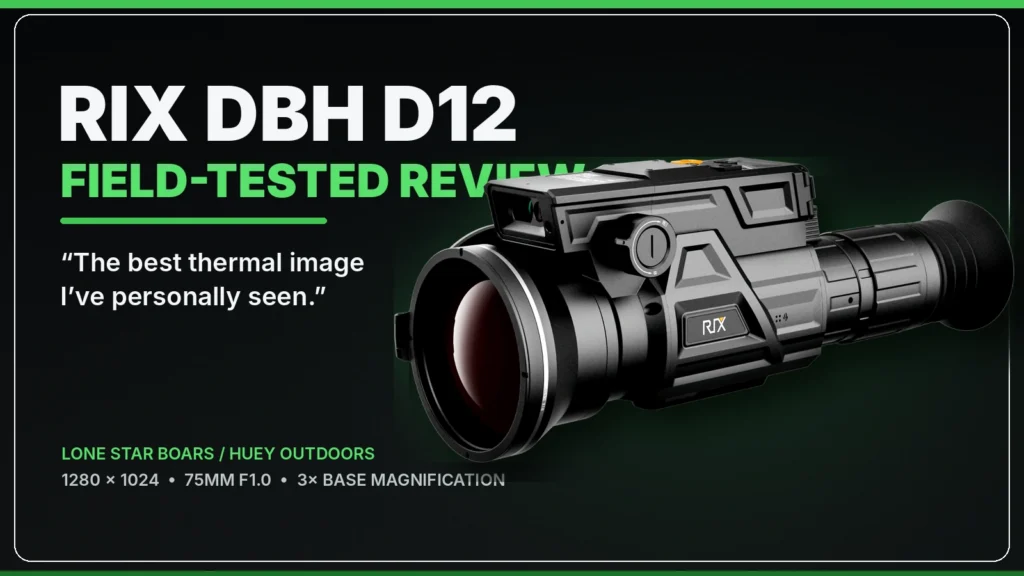
There are a lot of thermal scopes with impressive specifications.
There are now more 1280-resolution thermals than ever before, and every manufacturer wants to tell you that its newest flagship has the best image, the greatest detection range, or the most advanced processing.
I do not rank thermal scopes from specification sheets alone.
For my original RIX DBH D12 review, I spent five days on a ranch comparing it with the thermal scopes I had available, including premium 1280 and 640 models. I used it in changing weather and watched what happened as humidity increased.
Before that test, the 640-resolution RIX DBH D6 had become one of my favorite thermals.
The D12 changed my mind.
The RIX DBH D12 produced the best thermal image I have personally seen through a commercially available thermal optic.
That is not a laboratory measurement or a claim that it will outperform every thermal in every possible condition. It is my firsthand judgment after using it in the field and comparing it with the other thermals available to me.
The D12 did not win me over because one number on the box was larger.
It won because of the complete combination:
The result is a premium long-range thermal scope that gives you magnification, detail, and field of view at the same time.
Shop the RIX DBH D12 at Huey Outdoors:
The major published specifications include:
Specifications help explain what a thermal scope is capable of, but they do not tell the entire story.
The real question is what the complete system looks like through the eyepiece when conditions are not perfect.
I spent five days on a ranch comparing the D12 with the other thermal optics I had available.
The image was excellent in good conditions, but that alone was not what impressed me most. Many premium thermals look good on a cool, dry night when the animal is much warmer than the background.
The more revealing test is what happens as humidity rises and the thermal contrast begins to disappear.
Humidity can flatten a thermal image. Grass, trees, dirt, water, metal, and animals begin blending into similar shades. The scope may still detect the heat source, but environmental detail can become soft or disappear.
The D12 held its image together exceptionally well.
As conditions became more difficult, the D12 continued showing detail in the ground, vegetation, trees, and background that other optics were losing.
That high-humidity performance is a major reason I describe it as the best thermal image I have personally used.
No thermal scope can completely defeat humidity. Water vapor in the air affects the infrared energy reaching every thermal detector.
What impressed me was how much useful detail the D12 retained compared with the other scopes I was using under the same conditions.
A 1280×1024 sensor has four times the total detector pixels of a 640×512 sensor:
That does not mean every 1280 automatically shows four times as much useful detail as every 640.
Final image quality also depends on:
A poorly designed 1280 can still produce a disappointing image.
The DBH D12 combines the higher-resolution detector with a large 75mm F1.0 objective, low NETD, a high-resolution OLED display, and image processing that worked extremely well in my field use.
That complete combination is what makes the D12 special.
For a deeper explanation of sensor resolution, field of view, lens design, and digital magnification, read our complete 640 vs. 1280 thermal scopes comparison.
One of the most impressive parts of the D12 is not simply its resolution.
It is the field of view.
The RIX DBH D12 and DBH D6 both have a stated 3× base magnification.
However, their published angular fields of view are very different:
That gives the D12 approximately 60% more horizontal and vertical angular coverage at the same stated 3× base magnification.
That is a major real-world difference.
Normally, a hunter has to choose between magnification and field of view.
A longer lens and higher starting magnification help make distant animals appear larger, but they also narrow the visible area. A wider field of view makes it easier to scan and track moving animals, but it normally comes with lower magnification.
The D12 gives you the useful image scale of a 3× long-range optic while showing substantially more of the landscape.
That matters when:
It is much easier to find and stay on a moving hog when you can see more of the area around it.
The D12 does not feel like you are looking through a narrow tube, even though it starts at 3×.
The D12 uses a large 75mm F1.0 objective.
That lens helps provide the image scale expected from a long-range thermal while working with the physically larger 1280 sensor.
A longer focal length makes a distant target occupy more detector pixels. The target appears larger on the sensor, which can improve the potential for detection and identification.
The normal tradeoff is a narrower field of view.
The much larger 1280 sensor helps the D12 retain a broad view while the 75mm objective provides useful magnification.
That is why the sensor and lens must be evaluated together.
A 1280 sensor with a small lens may produce an extremely wide image but not provide enough base magnification for a hunter who expects longer shots.
A long lens on a smaller sensor may provide magnification but create a very narrow view.
The D12 combines the two in a way that gives you both.
The 75mm objective also makes the D12 physically larger than a compact thermal scope. This is not an optic designed to disappear on top of the rifle.
That size is part of the tradeoff for the lens, field of view, and long-range image it delivers.
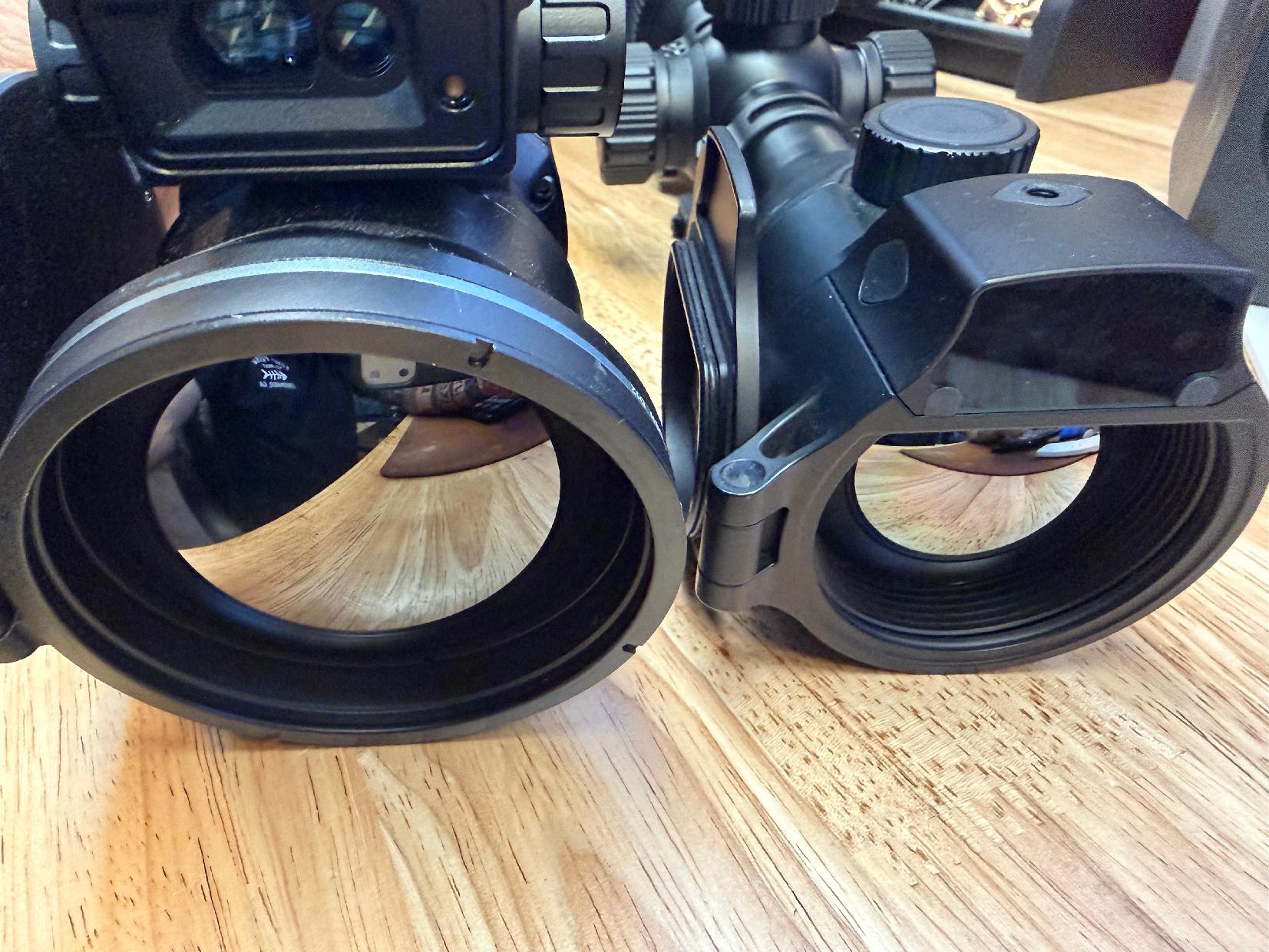
RIX DBH D12 75mm objective beside a smaller 50mm thermal objective. The D12’s lens shows how substantial the optical system really is.
Digital zoom works by cropping the sensor image and enlarging the remaining center portion.
When digital magnification doubles, the scope uses approximately half the sensor width and half the sensor height. That leaves roughly one-quarter of the original total detector pixels contributing real image information.
This is where 1280 gives the hunter much more room to work.
In a simplified 2× digital crop, moving the D12 from 3× to approximately 6× still leaves about 640×512 original source pixels contributing to the image.
A native 640×512 sensor at the same digital-zoom step would be using approximately 320×256 original pixels.
Image processing can smooth and sharpen the enlarged image, but it cannot recreate target information that was discarded by the crop.
The D12 starts with four times the total pixels of a 640 sensor, so it can tolerate much more digital enlargement before the image begins breaking down.
The D12 also uses fine-step digital magnification.
Instead of forcing the shooter to jump immediately from one large magnification step to another, the image can be increased more gradually.
That is useful because you can apply only as much magnification as the situation requires.
The D12 is listed with total magnification up to approximately 20×. That does not mean the image retains native 1280 resolution at maximum magnification.
Every digital increase costs resolution.
The advantage is that the D12 begins with far more image information than a lower-resolution sensor.
The D12 pairs its 1280×1024 thermal sensor with a 2560×2560 OLED display.
A high-resolution display cannot create thermal information that the sensor never captured.
However, it can present the available sensor image more cleanly and give the eyepiece system enough display resolution for fine-step enlargement.
The image through the D12 feels detailed and natural rather than looking like a low-resolution thermal image stretched across a large screen.
The display, sensor, lens, and processing all have to work together.
A high-resolution sensor feeding a low-resolution display can waste some of the potential detail.
A high-resolution display connected to a weak sensor cannot manufacture detail.
The D12 combines both parts of the system effectively.
The D12 has several different distance figures associated with it, and they should not be confused.
RIX lists:
Detection means the thermal system may recognize that a heat source is present under favorable conditions.
It does not mean the hunter can positively identify the target at 4,260 yards.
At extreme distance, a heat source may only appear as a few pixels. You may know something warm is there without knowing whether it is a hog, deer, calf, coyote, person, or another animal.
Identification requires enough image detail to determine what the target actually is.
The laser rangefinder is a separate system. It measures the distance to a reflective target and can provide that distance to the onboard ballistic calculator.
Neither the detection figure nor the maximum rangefinder figure is a recommended shooting distance.
The hunter still has to positively identify the animal, understand the background, know the rifle and ammunition, and make an ethical decision based on actual conditions.
The D12 includes a built-in laser rangefinder rated to approximately 1,312 yards under favorable conditions.
The onboard ballistic system can store multiple profiles.
After the shooter enters the correct rifle and ammunition information, the scope can use the measured distance as part of the firing solution.
Ballistic calculators become especially useful when:
The system is only as accurate as the information entered.
Velocity, ballistic coefficient, sight height, zero distance, temperature, pressure, and other variables all affect the solution.
A ballistic calculator does not replace confirming the rifle and ammunition at the range.
It is a tool that can become very useful once the profile has been entered and verified correctly.
The D12 also includes a visible green laser pointer.
This is separate from the laser rangefinder.
The visible laser can help indicate a location to another hunter. For example, it can be used to point toward where an animal entered tall grass, where a downed animal is located, or where another person should begin searching.
Like every visible laser, it must be used safely and responsibly.
It should never be directed toward people, vehicles, aircraft, or anything that could create a safety hazard.
The D12 includes the features expected from a premium modern thermal optic:
The dual-side focus controls are a practical feature.
They allow left- and right-handed hunters to adjust focus from either side of the optic instead of forcing the shooter to reach across a large housing.
Small ergonomic details do not receive the same attention as sensor resolution, but they matter when the scope is actually being operated at night.
The DBH D6 remains a strong thermal scope.
It uses a 640×512 sensor and a 60mm objective. It also starts at a stated 3× base magnification.
The biggest practical differences are:
The D6 had been one of my favorite thermals.
The D12 took the basic idea and gave me substantially more field of view, more sensor resolution, and the best image I have personally seen.
That does not make the D6 obsolete.
A hunter has to decide whether the D12’s performance increase is worth the much higher price.
Humidity is one of the conditions I care about most when evaluating a thermal optic.
Texas hunting does not always happen on a cold, dry night.
Warm ground, moisture, clouds, vegetation, standing water, and high humidity can remove much of the thermal contrast from the scene.
A scope that looks spectacular in perfect conditions may look completely different when the air becomes thick and humid.
The D12 impressed me as the humidity increased.
It continued showing environmental detail and separation that other thermals were losing.
The image did not become immune to humidity. Nothing does.
But the D12 held together better than the other commercially available thermal optics I had used and compared under those conditions.
That is more important to me than a scope producing the prettiest image during an easy test.
I need to know what it does on the difficult nights when I am actually hunting.
The D12 is not a compact thermal.
The large 75mm objective, rangefinder, battery system, controls, and housing create a substantial optic.
For some hunters, that will be an acceptable tradeoff for the performance.
For others, it may be more scope than they want to carry.
The D12 makes the most sense when:
A smaller thermal may be more practical when:
The D12 is a specialized premium tool.
It should be selected because its strengths match the way the hunter actually hunts.
The D12 is best suited to hunters who want:
It is especially well suited to open ranches, large fields, longer shooting lanes, and situations where positive identification at distance is important.
The D12 may not be the best choice for someone who wants:
A strong 640 thermal can handle the majority of normal hog-hunting situations for substantially less money.
The D12 is for the buyer who wants premium performance and understands the cost, size, and weight that come with it.
The D12 is not inexpensive.
It sits in the premium end of the thermal market, and the buyer should expect a real performance advantage for that investment.
For me, the D12 delivered that advantage.
It did not simply show me a higher-resolution version of the same narrow image.
It gave me:
That does not mean every hunter needs one.
A person taking 75-yard shots at a feeder does not need the same equipment as someone hunting large Texas ranches, identifying animals across wide fields, or demanding the strongest image available.
Value depends on the job.
For the hunter who prioritizes premium image quality, wide field of view, and longer-range performance, the D12 earns its place.
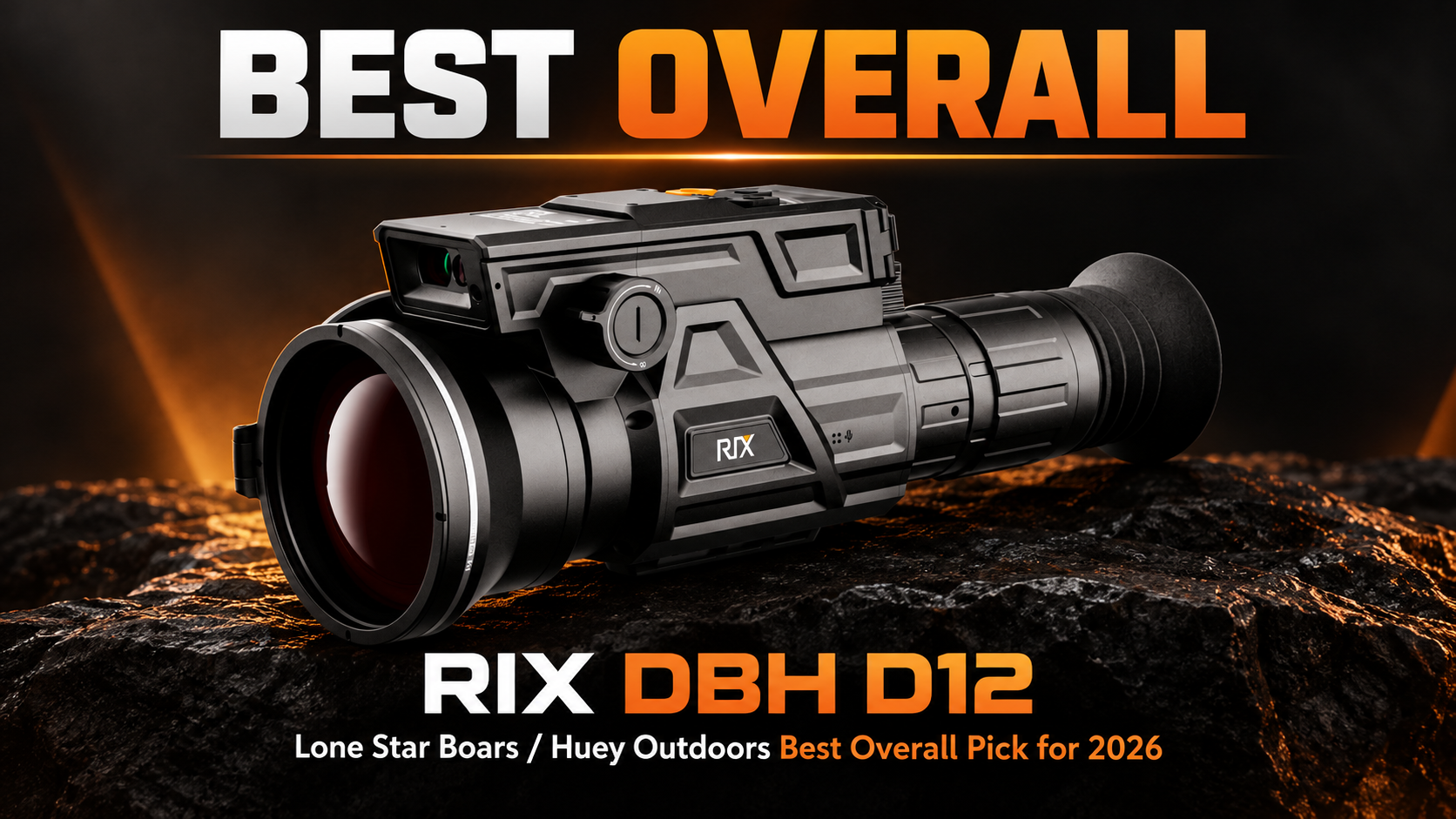
The RIX DBH D12 is my Best Overall Thermal Scope Pick for 2026.
It also earns my picks for:
The D12’s greatest strength is not one individual specification.
It is the way the 1280 sensor, 75mm objective, 3× magnification, wide field of view, thermal sensitivity, display, and processing work together.
The image is exceptional.
The field of view is dramatically wider than the 640 DBH D6 at the same stated base magnification.
The additional resolution provides much more room for digital magnification.
And in my field use, the D12’s performance as humidity increased separated it from the other thermal optics I had available.
It is large.
It is expensive.
It is not the right scope for every hunter.
But when I am asked which commercial thermal has produced the best image I have personally seen, my answer is the RIX DBH D12.
Shop the RIX DBH D12 at Huey Outdoors:
Huey Outdoors offers free ground shipping on qualifying orders and covers the sales tax for the customer.
Watch my complete field review:
BEST THERMAL OPTIC RIX DBH D12
Read my original Lone Star Boars field report:
See why the D12 earned the Best Overall award in my complete buying guide:
Best Thermal Scopes for Hog Hunting in 2026: Field-Tested Picks
The D12 uses a 1280×1024 thermal sensor with a 12-micron pixel pitch.
The D12 starts at a stated 3× base magnification and provides fine-step digital enlargement up to approximately 20× total magnification.
Its published angular field of view is 11.7° × 9.3°. That is approximately 60% greater horizontal and vertical angular coverage than the 640-resolution DBH D6, even though both have a stated 3× base magnification.
The D12 provides higher sensor resolution, a larger 75mm objective, substantially more field of view at the same stated base magnification, and more resolution available for digital zoom.
The D6 remains a capable and less expensive 640 thermal. The better choice depends on budget, size preference, and how much the hunter values premium 1280 performance.
RIX lists a maximum detection range of approximately 4,260 yards under favorable conditions.
Detection does not mean positive identification. The ability to identify an animal depends on its size, weather, humidity, background, focus, magnification, and other conditions.
The built-in laser rangefinder has a manufacturer-listed maximum range of approximately 1,312 yards under favorable conditions.
In my field experience, the D12 delivered the best high-humidity image I have personally seen from a commercially available thermal optic. No thermal is immune to humidity, but the D12 retained exceptional environmental and target detail as conditions became more difficult.
It can be for hunters who want maximum detail, more digital-zoom reserve, wider high-resolution views, and better long-range identification potential.
A quality 640 thermal is still more than capable for most normal hog-hunting situations and may provide better value for many hunters.
No. The D12 is a large premium thermal built around a 75mm objective and a full feature set. Hunters prioritizing minimum size and weight may prefer a smaller 640 or compact 1280 model.
Yes. The D12 includes integrated laser ranging and onboard ballistic calculation with multiple profiles and RIX+ app connectivity.
I selected it because it combined the best thermal image I have personally seen with 3× starting magnification, a much wider field of view than the 640 DBH D6, strong digital-zoom reserve, exceptional humidity performance, and a complete field-ready feature set.