

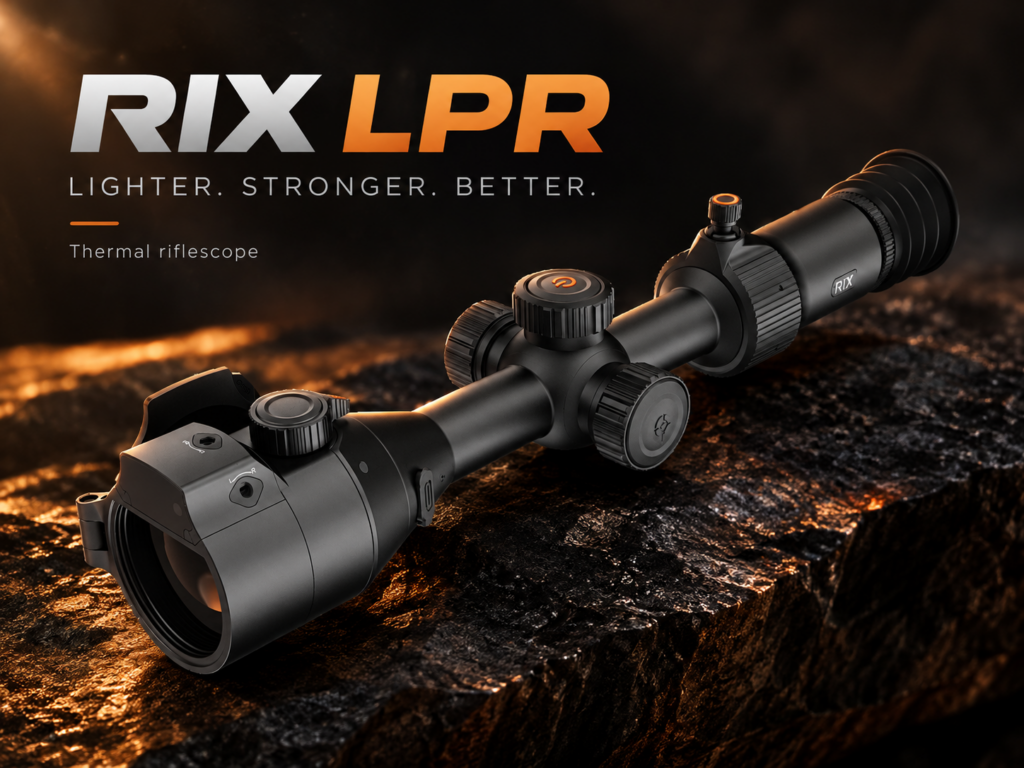
The RIX LPR L6R is not one of those product updates where a manufacturer changes the name, moves a button, and calls it an entirely new thermal scope.
This is a real redesign.
I had just returned from a couple of days of hunting during which we killed more than 70 hogs, and the LPR L6R was the scope I had been using. I was exhausted when I recorded the original review, but I came home impressed with what RIX had changed.
At first glance, the new LPR L6R looks a lot like the discontinued RIX LEAP L6R it replaces.
It still has:
But nearly every major part of the system has been upgraded.
The body is lighter. The housing is magnesium alloy. The thermal sensor is more sensitive. The display is much larger and higher resolution. The rangefinder is more powerful and can be mechanically aligned with the aiming reticle. The focus control is easier to reach. The optical eyepiece zoom is smoother. The battery is larger. Environmental sensors now feed temperature, humidity, and barometric pressure into the ballistic calculator.
My overall verdict is simple:
The RIX LPR L6R is lighter, stronger, easier to operate, and produces a substantially better image than the LEAP L6R it replaces.
It is not the least expensive 640 thermal scope available, but for someone who wants a traditional tube-style design, strong long-range capability, optical eyepiece magnification, integrated ranging, and a complete ballistic system, it is one of the most capable 640 thermals I have used.
Shop the RIX LPR L6R at Huey Outdoors:
The major manufacturer-listed specifications include:
Specifications describe the parts inside the scope. The important question is how those parts work together in the field.
The LPR L6R replaces the first-generation RIX LEAP L6R.
The two scopes look similar enough that someone unfamiliar with them could mistake one for the other. Both are traditional tube-style thermal scopes with 30mm mounting tubes, a 50mm objective lens, integrated rangefinding, and adjustable eyepiece magnification.
The differences become obvious as soon as you pick them up and look through them.
The most important upgrades are:
The LPR is not simply a lighter LEAP.
It is a stronger and more refined version of the entire concept.
RIX states that the LPR L6R is approximately 30% lighter than the original LEAP platform.
I wanted to see what that meant on the rifle, so I weighed the actual complete setups I was using.
Both measurements included the mount and battery.
| Complete setup | Measured weight |
|---|---|
| RIX LPR L6R with mount and battery | 2.48 lb |
| Original RIX LEAP L6R with mount and battery | 3.36 lb |
| Difference | 0.88 lb / approximately 14.1 oz |
Based on my two mounted setups, the LPR was approximately 26% lighter.
That is close to RIX’s approximately 30% claim, but I keep the two figures separate because RIX’s number is a manufacturer comparison and mine came from the complete setups on my own scale.
Fourteen ounces is not a tiny difference.
That amount of weight changes how the rifle balances, how quickly it comes onto target, and how tiring it becomes when carried for hours.
For additional context, I weighed two other complete setups:
Those are not controlled factory measurements, and the included mounts and batteries differ. They are simply the real setups I had available and weighed on the same scale.
The important point is that the LPR L6R is genuinely light for a full-featured 640 thermal scope with a 50mm lens, integrated rangefinder, optical eyepiece magnification, and ballistic capability.
The original LEAP L6R used a 640×512 sensor rated under 20 mK.
The LPR L6R uses a 640×512 sensor rated under 12 mK.
NETD describes how small a temperature difference the thermal system can distinguish. Lower is generally better.
A lower NETD does not automatically guarantee a perfect image. Lens quality, focus, image processing, display, humidity, and other factors still matter.
But when the complete system is designed correctly, improved thermal sensitivity allows the scope to separate smaller temperature differences in:
That is what I saw in the side-by-side comparison.
The new LPR showed more detail in the animals, more texture in the grass, and more separation in the background than the original LEAP.
This was not simply a sharper outline around the target.
The entire scene contained more useful thermal information.
The display is one of the first changes you notice when looking through the scope.
The old LEAP L6R used a 0.49-inch 1920×1080 display.
The LPR L6R uses a 1.03-inch 2560×2560 AMOLED display.
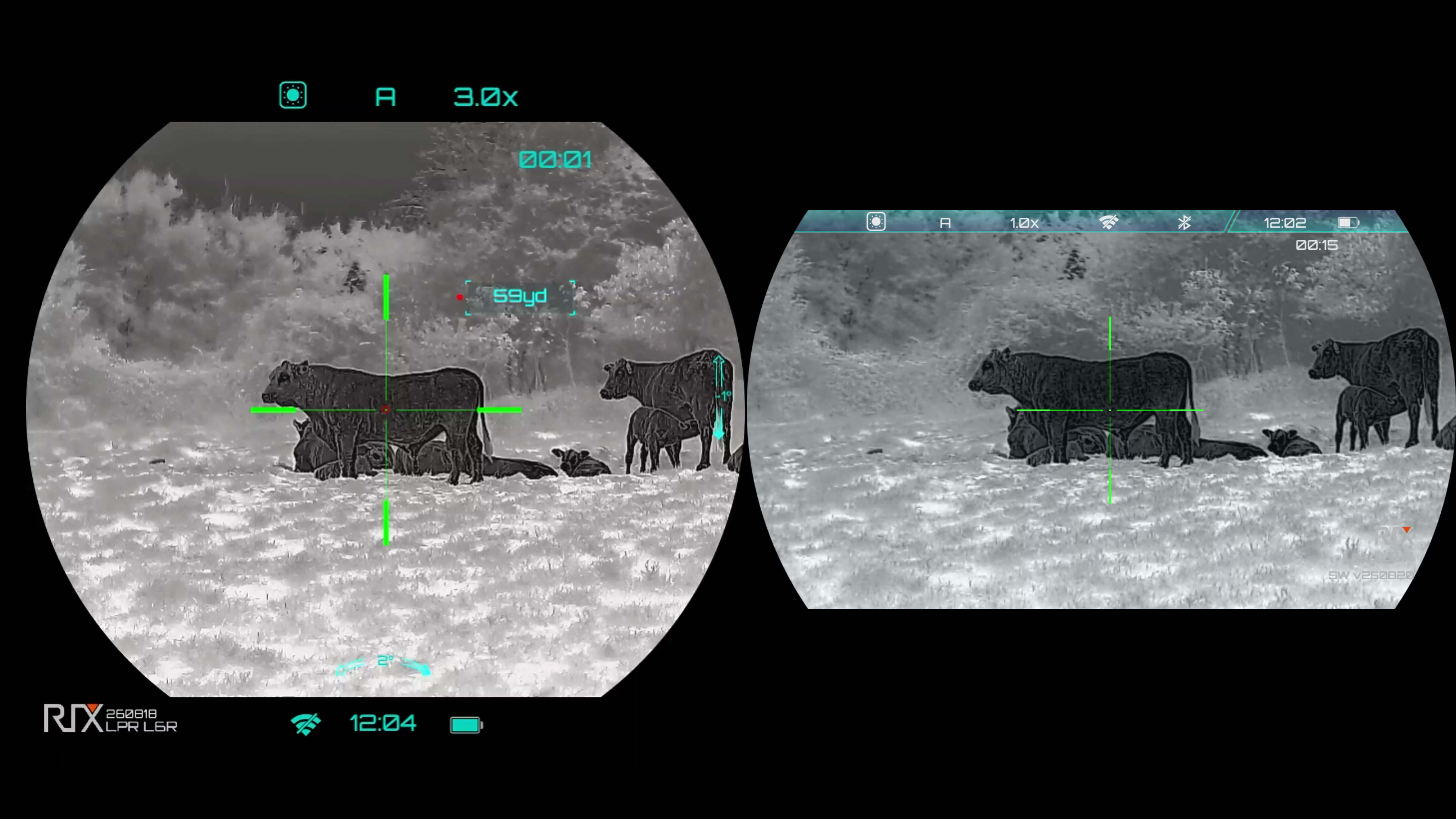
The thermal detector is still 640×512. A larger display does not change the sensor resolution.
Sensor resolution and display resolution describe two different parts of the system:
The much larger display gives you more visual real estate through the eyepiece. Combined with the more sensitive sensor, it makes the image feel larger, cleaner, and easier to evaluate.
In the side-by-side footage, the LPR showed more detail in the grass, animals, and background.
Looking directly through the eyepiece, the difference is even more noticeable than it appears in recorded video.
Onboard video is compressed, edited, and then viewed on another screen. It cannot perfectly reproduce what your eye sees through the optic.
The eyepiece image is where the new display makes the strongest impression.
I compared the new LPR L6R with the original LEAP L6R on the same cattle at the same time.
At approximately 59 yards, the LPR showed:
At approximately 128 yards, the LPR continued showing good detail in both the target and the environment around it.
Branches above the target remained visible. Trees behind it remained acceptably defined. The animal remained in focus.
That leads to another advantage that does not always receive enough attention: depth of field.
Some modern thermal scopes chase maximum image sharpness with very fast optical systems and extremely narrow focus ranges.
They may look spectacular when focused perfectly at one distance.
The problem appears when animals begin moving.
You may have one coyote at 120 yards, another at 80 yards, and another approaching from 40 yards. A sounder of hogs may spread out across a field with animals at several different distances.
A thermal that keeps only a narrow slice of the scene sharp forces the hunter to keep adjusting focus.
The LPR L6R maintained a useful range of acceptable focus in my field testing.
At approximately 128 yards:
The image may not be mathematically perfect at every distance, but in real hunting conditions it gives you enough depth of field to follow animals that are moving closer, farther away, and across different parts of the scene.
That matters more to me than a scope producing a razor-sharp test image at one exact distance and becoming blurry everywhere else.
One of the defining features of the LPR and LEAP designs is the adjustable eyepiece magnification.
RIX lists the LPR L6R with:
I usually call the first system ocular or eyepiece zoom.
It enlarges the display image through the rear optical system. It does not work exactly like a conventional variable daytime scope where moving objective-lens groups change the actual optical field of view.
The practical advantage is that it enlarges what you see through the eyepiece without immediately cropping away sensor pixels in the same way digital zoom does.
Digital zoom works by cutting away the outside of the sensor image and enlarging the center.
Every time digital magnification increases, you lose some original image information.
In my review footage, maximum digital zoom clearly showed the tradeoff. The animal appeared larger, but the image lost resolution.
I also held my phone behind the eyepiece while adjusting the optical eyepiece magnification.
The difference was obvious.
As I increased the ocular magnification, the displayed image became larger without the same immediate loss of detail seen with digital cropping.
Then I could add digital zoom on top of that when more magnification was needed.
That combination gives the LPR a tremendous amount of usable magnification for a 640 thermal.
At high combined magnification, digital zoom still reduces detail. Nothing avoids that basic limitation.
The advantage is that you can use the optical eyepiece system first and save the digital crop for when it is actually needed.
For a deeper explanation of sensor resolution and digital magnification, see our complete 640 vs. 1280 Thermal Scopes comparison.
The original LEAP eyepiece magnification could feel stiff.
The LPR is much smoother.
You can rotate the rear control directly or use the throw lever. The movement is easier and more precise, which matters when adjusting magnification while keeping an animal in view.
The digital control is located near the same area, allowing you to transition from optical eyepiece enlargement to digital zoom without moving your hand far from the shooting position.
The improvement is not as dramatic on a specification sheet as the sensor or display, but it makes the scope easier to use.
The original LEAP used a front focus ring with a throw lever.
Some users found it stiff.
The LPR moves the focus control to a knob on top of the scope.
I prefer the new arrangement.
The top focus knob is:
Again, this is the type of change that sounds small until you use the scope at night.
When a hog is moving and the distance is changing, faster and easier focus control matters.
This is one of the best improvements in the entire scope.
Many thermal rangefinders show a separate box or indicator representing where the ranging laser is aimed.
That box may not line up with the aiming reticle after the rifle is zeroed.
The optic’s reticle moves electronically during zeroing, but the laser rangefinder remains physically pointed in the same direction. The two may no longer match.
The LPR L6R includes mechanical windage and elevation adjustments for the rangefinder.
That allows you to align the rangefinder’s point with the aiming reticle.
I used a Coke can at 100 yards.
I locked the rifle in place, placed the aiming reticle on the can, and used the included screwdriver to adjust the rangefinder until it aligned with the same point.
After alignment, the reticle effectively becomes the place where I range.
That is much less distracting than trying to position a separate ranging box over a moving animal.
The scope also makes the ranging point easier to see by changing its color relative to the reticle.
In my setup:
That contrast helped draw my eye to the correct point.
I especially liked it when tracking moving targets.
The indicator remained visible without becoming a large obstruction over the animal.
RIX rates the LPR L6R’s laser rangefinder to a maximum of 2,187 yards, or 2,000 meters, under favorable conditions.
The original LEAP rangefinder was rated around 1,300 yards.
Most hunters are not going to shoot a hog at 2,187 yards.
That is not the point.
A more powerful laser can provide better performance on:
Maximum range is normally measured against a highly reflective target.
A small coyote or hog is much less reflective.
The additional laser power can therefore improve useful ranging performance at normal hunting distances even when you never approach the advertised maximum.
There is one setup detail I learned the hard way.
After zeroing the rifle, the reticle position may have moved.
If you enter the rangefinder-alignment menu and press Save without checking or adjusting the mechanical rangefinder alignment, the ranging point may no longer match the reticle.
During one hunt, my display showed a pig at 313 yards even though the pigs were actually approximately 122 yards away.
The rangefinder was measuring the background because the ranging point and reticle were no longer aligned.
Once I recognized what had happened and rechecked the setup, the correct distances appeared.
The lesson is simple:
After changing the rifle zero or saving changes in the alignment menu, verify that the rangefinder and reticle are still aligned.
Do not assume they remain matched after other adjustments.
The scope supports five profiles, labeled A through E.
Those can be used for:
The menu shows which controls to use, making setup easier than menus that rely on unlabeled icons and memorized button sequences.
The ballistic calculator can then use the measured range and stored rifle data to provide a firing solution.
As with every ballistic system, the result is only as good as the information entered.
You still need to verify:
The calculator is a tool, not a replacement for range testing.
The LPR L6R includes sensors for:
These are built into the scope. They are not a separate Kestrel-brand device.
When enabled, the readings can provide local atmospheric inputs to the ballistic calculator.
That can make the firing solution more complete than using distance alone.
The sensors do not measure wind speed or wind direction.
Wind still requires the shooter’s judgment or a separate wind-measuring device.
The environmental system is optional. You can leave it off when it is not needed.
The LPR L6R uses replaceable 21700 rechargeable batteries.
They are larger than the 18650 batteries used in many thermal scopes and provide more capacity.
RIX includes two batteries.
For hunters who already own a collection of 18650 batteries, RIX also includes an adapter sleeve.
Insert the 18650 into the sleeve, and it can be used in the LPR.
That is a thoughtful addition because many thermal hunters already have chargers and spare 18650 batteries.
The scope also accepts 5V USB-C external power.
RIX lists approximately 5.5 hours of operation at 72°F. Actual runtime depends on:
The LPR includes RIX’s return-to-zero mount.
It can also be installed with other compatible 30mm rings.
That gives hunters flexibility in mounting height, position, and rifle setup.
I have had no problem with the included mount returning to zero in my use.
The eyecup screws onto the rear instead of simply slipping over it, which reduces the chance of it loosening or falling off.
Specification sheets are useful, but I care more about what happens when the weather turns ugly.
During one of the recorded hunts, humidity was approximately 82%.
Fog was hanging in the low areas, roughly three feet deep in places.
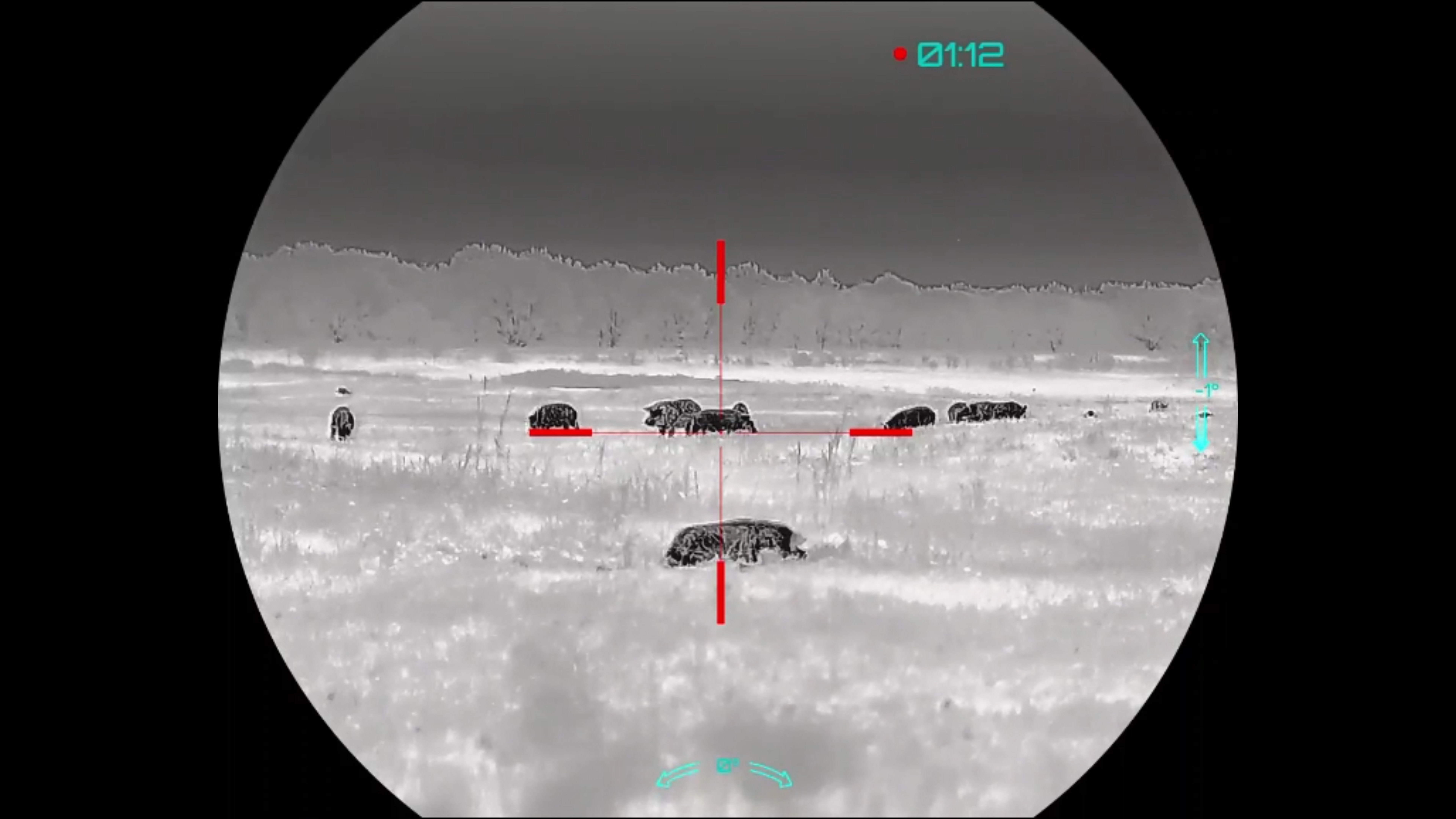
Those are difficult thermal conditions.
Water vapor reduces thermal contrast and can make the entire scene appear flat.
The LPR maintained an impressive image.
The animals remained clear, and the scope continued showing useful environmental detail.
RIX thermals have generally performed well for me in high humidity, and the LPR continued that pattern.
This was not a controlled laboratory humidity test.
It was a real hunt in the conditions we happened to have.
That is the type of performance that matters to me.
During the hunt, two boars were fighting.
One began circling away and moved behind a tree.
The tree ranged approximately 175 yards.
The boar later came back into view at approximately 198 to 200 yards.
The scope gave me enough image detail to track him as he moved, identify the target, and place the shot.
After the shot, the thermal sensitivity was strong enough to show extremely fine heat and movement detail around the hit area from approximately 200 yards.
That is exceptional performance from a 640-resolution thermal.
It also demonstrates why the complete system matters more than sensor resolution alone.
The LPR combines:
That combination performs far beyond what someone might expect from simply reading “640×512” on a specification sheet.
The reticle design was similar between the old LEAP and new LPR, but it appeared larger and easier to follow on the new display.
The lines remained fine enough that I could still aim precisely without covering a small target area.
The larger presentation made the reticle easier to track while animals were moving.
For hog and coyote hunting, that is a good balance.
A reticle that is too fine can disappear against complicated thermal backgrounds.
A reticle that is too thick can cover too much of the animal.
The LPR’s presentation worked well for me.
The LPR records 1280×1280 video to its 64 GB of internal storage.
That is higher than the native 640×512 detector resolution, but recording resolution does not create additional thermal detail.
The recording is still based on the information captured by the 640 sensor.
The onboard recording also does not show the effect of the optical eyepiece magnification in the same way the hunter sees it.
That is why I held my phone behind the eyepiece to demonstrate the ocular zoom.
Even that phone footage does not look as clean as the direct view.
When judging this scope, understand that online video cannot perfectly reproduce the experience through the eyepiece.
At the time of my review:
Prices can change, so check the current product pages before purchasing.
The approximately $600 difference bought substantial upgrades:
The original LEAP L6R remains a capable thermal.
For someone trying to save as much money as possible, remaining clearance inventory may still make sense.
For a new buyer planning to keep the scope for several years, I believe the LPR is worth the difference.
No single thermal is automatically best for every hunter.
The LPR is especially strong when someone wants:
A compact 640 with a shorter lens may be better for hunters who primarily shoot at very close range or prioritize the widest possible native field of view.
A premium 1280 may provide more source resolution and more digital-zoom reserve, but at a much higher price.
The LPR occupies an attractive middle ground: a complete, long-range-capable 640 system with an unusually good viewing experience and a large feature set.
The LPR L6R is best suited to hunters who want:
It should work especially well for:
Another thermal may be more appropriate for someone who wants:
The LPR is lighter than the LEAP, but it is still a full-length tube-style thermal with a 50mm objective.
It is not intended to replace a compact short-body scope.
No review is complete without discussing the disadvantages.
The main tradeoffs are:
At approximately $4,499 during my review, this is still a significant purchase.
Three-power starting magnification is useful at distance but may feel tighter than a 2× or 2.5× thermal when animals suddenly appear very close.
The adjustable rangefinder is a major advantage, but it must be aligned correctly and rechecked after changes.
The 21700 battery provides more capacity, but hunters with large collections of 18650 batteries may initially dislike the change. The included sleeve solves most of that problem.
The feature is much more impressive through the eyepiece than in onboard recordings.
None of those tradeoffs change my overall opinion, but buyers should understand them.
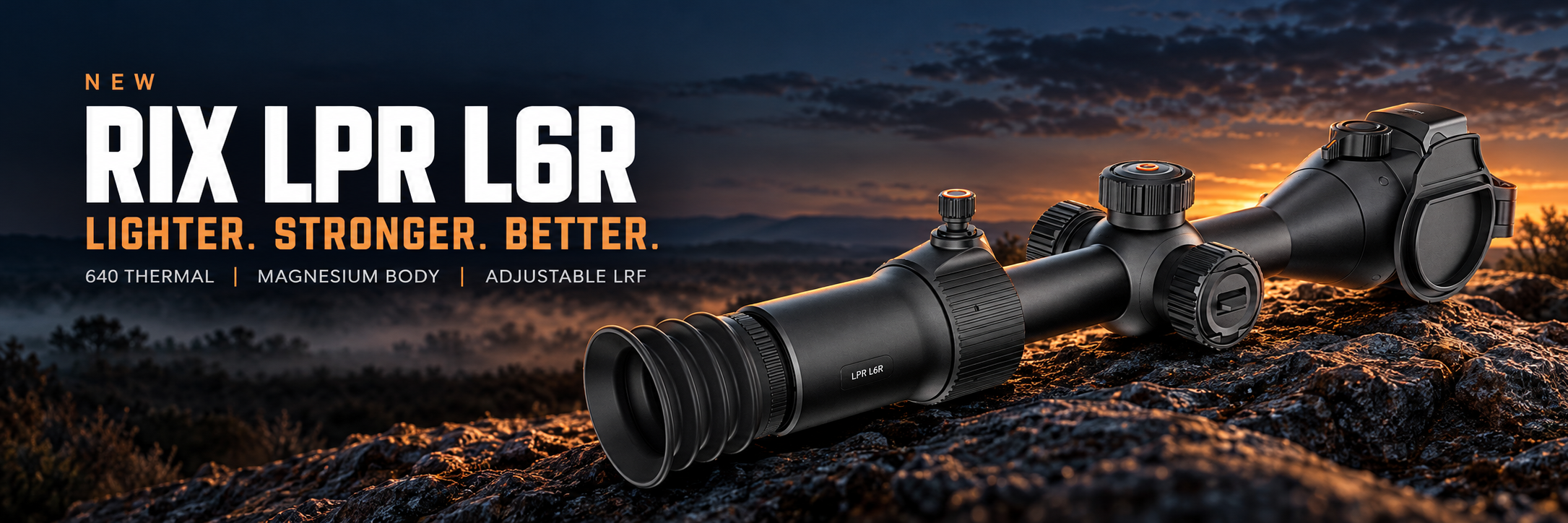
The RIX LPR L6R is one of the most meaningful thermal updates I have tested.
RIX did not simply rename the LEAP and put it in a new box.
The LPR is:
The measured 14.1-ounce reduction in my mounted setup is substantial.
The sub-12 mK sensor provides impressive environmental and target detail.
The 1.03-inch 2560×2560 display dramatically improves the viewing experience.
The adjustable 2,187-yard rangefinder solves one of my longstanding complaints about integrated thermal rangefinders.
The optical eyepiece magnification gives you more usable image enlargement before relying heavily on digital cropping.
And during real hunting in 82% humidity and ground fog, the LPR continued delivering a strong image.
That is why the RIX LPR L6R earned the Lone Star Boars / Huey Outdoors Best Full-Featured Long-Range 640 Thermal Scope Pick for 2026.
It is not the least expensive 640 thermal.
It is one of the most complete.
Shop the RIX LPR L6R at Huey Outdoors:
Huey Outdoors offers free ground shipping on qualifying orders and covers the sales tax for the customer.
Watch the public Lone Star Boars review:
ALL NEW RIX LPR L6R — EVERYTHING IS BETTER
See how the LPR compares with other top thermal scopes in:
Best Thermal Scopes for Hog Hunting in 2026: Field-Tested Picks
The LPR L6R is a 640×512 tube-style thermal riflescope with a 50mm F0.9 objective, optical eyepiece magnification, digital zoom, an adjustable laser rangefinder, onboard ballistics, and environmental sensors.
Yes. The LPR L6R replaces the discontinued first-generation LEAP L6R.
RIX describes the new magnesium platform as approximately 30% lighter.
My complete LPR setup with mount and battery weighed 2.48 lb, compared with 3.36 lb for my complete LEAP setup. That was a difference of approximately 14.1 ounces, or about 26%, between the two setups I weighed.
The thermal sensor is 640×512 with a 12-micron pixel pitch and NETD under 12 mK.
No. The thermal detector is 640×512. The eyepiece display is a 1.03-inch 2560×2560 AMOLED.
The LPR L6R starts at 3×.
RIX lists 3–9× optical eyepiece magnification and 1–4× digital zoom.
RIX lists a maximum measuring range of 2,187 yards under favorable conditions.
That is a maximum reflective-target rating, not a recommended shooting distance.
Yes. Mechanical windage and elevation adjustments allow the rangefinder point to be aligned with the aiming reticle.
Yes. It supports onboard ballistic calculation and five profiles. Built-in sensors can provide temperature, humidity, and barometric-pressure information.
No. The environmental sensors do not measure wind speed or direction.
The LPR L6R uses a replaceable 21700 battery. It can also use an 18650 battery with the included adapter sleeve.
In my field use at approximately 82% humidity with fog in the low areas, the LPR maintained an impressive image and useful environmental detail.
For hunters who want less weight, better thermal sensitivity, a much larger display, adjustable rangefinder alignment, environmental sensors, easier focusing, and smoother eyepiece magnification, the upgrade is substantial.
An existing LEAP owner who is satisfied with the older scope does not suddenly have a bad optic. The decision depends on how much those improvements matter to the hunter.