

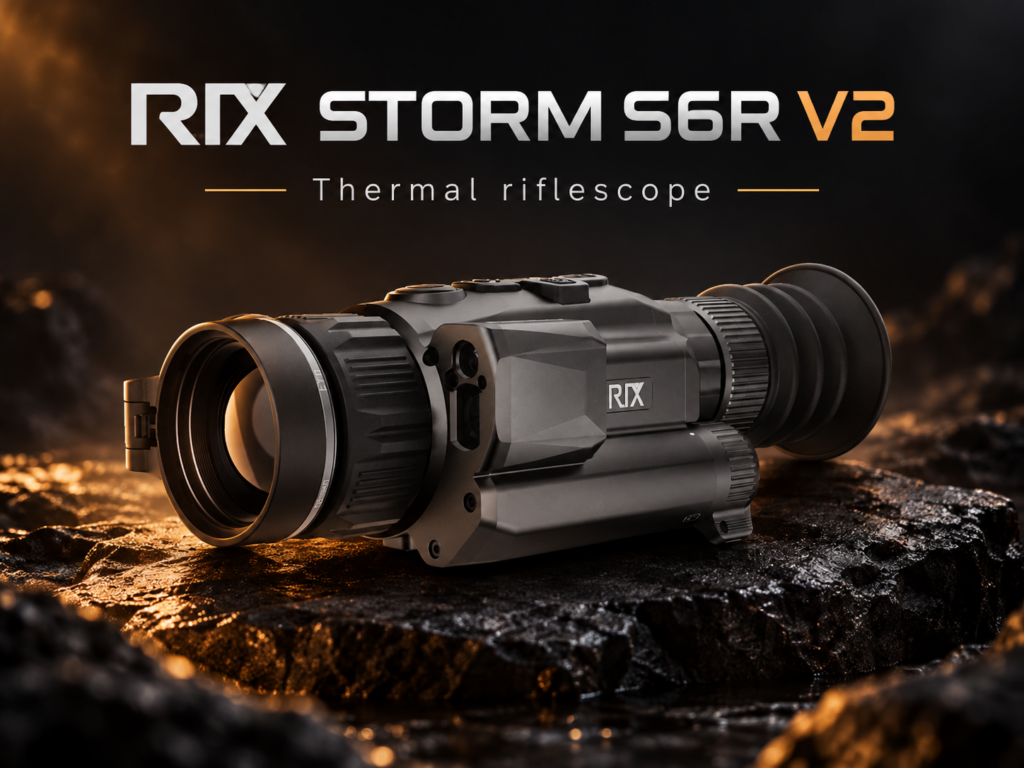
The original RIX Storm S6R became one of the best-selling thermal scopes at Huey Outdoors for good reason. It delivered a 640-resolution thermal image, an integrated laser rangefinder, ballistic calculations, and a compact one-pound design at a price that made it accessible to a lot of serious hog and predator hunters.
Now RIX has replaced it with the RIX Storm S6R V2.
At first glance, the two scopes look almost identical. The basic shape and compact size are familiar, but the V2 is much more than a cosmetic update.
RIX improved the thermal sensitivity, display, base magnification, field of view, laser rangefinder, mount layout, bolt-action compatibility, and several of the smaller details that affect how the scope performs in real hunting conditions.
I tested the original S6R and the new S6R V2 side by side, at the same time, on the same targets, in difficult Texas humidity. I also hunted with the V2 and used it on live hogs.
My conclusion is straightforward:
The RIX Storm S6R V2 is a substantial upgrade over the original Storm S6R and one of the strongest compact 640 thermal-scope values available in 2026.
Shop the RIX Storm S6R V2 at Huey Outdoors:

Here are the most important changes:
The original S6R remains a very capable thermal scope, but the V2 improves nearly every area that mattered most in actual use.
When you place the original S6R and the S6R V2 side by side, they look extremely similar.
The first noticeable physical change is the rangefinder.
On the V2, the rangefinder is molded more solidly into the housing and moved toward the left side of the optic. RIX also moved the quick-detach mount’s throw lever from the right side to the left.
That may sound like a small change, but it was done for a practical reason.
The original right-side arrangement could create clearance concerns on some bolt-action rifles. Moving the rangefinder and mount controls to the left gives the shooter more space around the bolt handle and action.
For hunters running the Storm on an AR-style rifle, the change may not seem dramatic. For someone using a bolt gun, it can make the optic much easier to mount and operate.
The original Storm S6R’s laser rangefinder was capable of reaching approximately 1,300 yards under favorable conditions.
The S6R V2 increases the maximum advertised measuring distance to 2,187 yards.
That is a major increase.
Most hunters will never shoot a hog or coyote anywhere near that distance, but the extra ranging capability still matters. A stronger rangefinder can provide more reliable readings on difficult targets, darker surfaces, smaller animals, vegetation, and objects that do not reflect the laser as well.
The V2 still works with the ballistic-calculation system. Once the correct rifle, ammunition, velocity, ballistic coefficient, zero distance, and environmental information are entered, the scope can calculate a firing solution based on the measured distance.
The V2 also includes visible level and angle indicators. These can show whether the rifle is tilted left or right or angled uphill or downhill.
You can turn those indicators off, but they can be helpful when making longer shots. A small amount of rifle cant may not look significant at close range, but the error becomes more important as distance increases.
One of the most important upgrades is the thermal sensitivity.
The original S6R used a sensor rated under 20 mK. The S6R V2 improves that rating to under 15 mK.
A lower NETD number means the thermal system can distinguish smaller temperature differences.
That matters because animals do not always stand against a cold, high-contrast background. In Texas, the ground, trees, grass, water, equipment, and air can all retain heat long after sunset.
Humidity can also reduce thermal contrast and make the entire scene look flatter.
A more sensitive thermal system can separate smaller temperature differences in the environment, producing more shades and more visible detail between the hottest and coolest areas of the image.
This does not mean the scope simply makes everything brighter. It means the V2 can show more of the subtle temperature changes that exist between the animal, grass, trees, ground, and other objects.
In my side-by-side testing, the improvement was obvious.
The original S6R used a 1024×768 display.
The S6R V2 uses a much higher-resolution 1920×1080 display.
That difference is more noticeable when looking through the eyepiece than it may appear in a recorded video.
A video file can be compressed, resized, edited, and viewed on different phones, tablets, and computer screens. Those steps make it difficult to reproduce exactly what the hunter sees through the optic.
Looking through the V2 directly, the display appears cleaner, wider, and more detailed.
The higher-resolution display also allows the improved sensor information to be presented more clearly to the hunter’s eye.
The sensor and display work together. A sensitive sensor can capture subtle thermal differences, but the display must still present those differences in a way that the hunter can see and use.
The V2 does a much better job of that than the original S6R.
The original Storm S6R started at approximately 2× base magnification.
The S6R V2 starts at approximately 2.5×.
Normally, increasing base magnification means sacrificing field of view. The target appears larger, but the hunter sees less of the surrounding area.
In my side-by-side test, the V2 gave me more starting magnification while also showing more of the scene.
That is a major practical advantage.
The increased magnification helps with target identification and shot placement, while the wider view helps the hunter:
At approximately 65 yards, the V2 showed cattle that were outside the original S6R’s visible image.
At approximately 200 yards, the animals appeared larger through the V2 because of the increased base magnification, but the V2 still showed more of the surrounding scene.
That combination is one of the strongest improvements in the new scope.
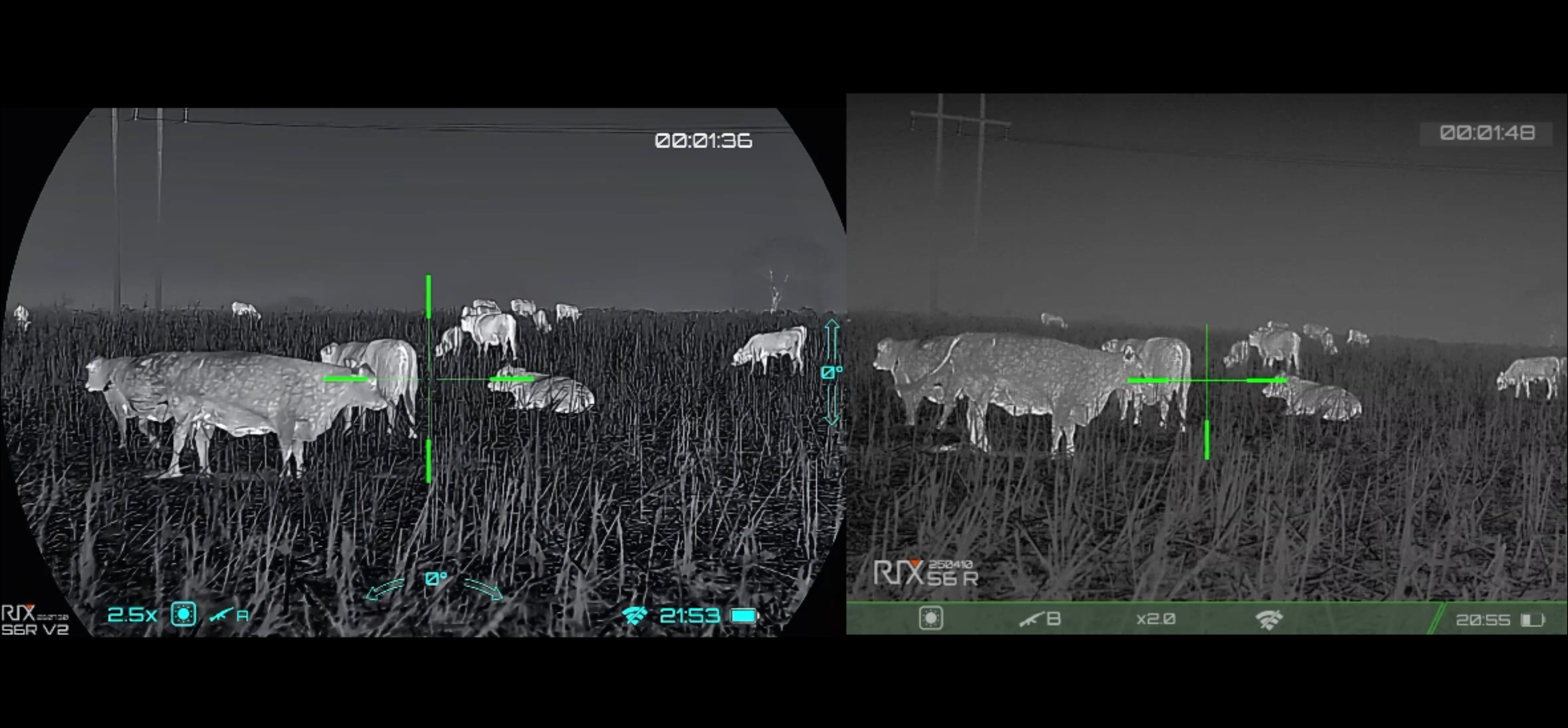
I tested the two scopes on the same night, at the same time, on the same cattle and background.
Humidity was approximately 68%. It had rained earlier in the day, storms had moved through the area, and nighttime temperatures were still in the 80s.
Those are not ideal thermal conditions.
Humidity reduces thermal contrast because water vapor in the air absorbs and scatters infrared energy. In difficult humidity, weaker thermal systems may still detect an animal but lose much of the detail in the background.
RIX scopes have generally performed well for me in humidity, but the difference between the original S6R and the V2 was still impressive.
The V2 showed noticeably more detail in:
In some areas of the image, trees and telephone poles were barely visible through the original S6R but clearly defined through the V2.
The power lines were also much crisper through the V2.
That improvement came from the complete system: the more sensitive sensor, higher-resolution display, and updated optical and image-processing design.
The difference was also noticeable when changing color palettes.
In White Hot and Black Hot, the V2 showed more texture and environmental detail.
In Red Hot, the V2 displayed more yellow and intermediate colors than the original S6R.
That does not mean the V2 was inventing colors. The improved sensitivity allowed it to recognize smaller thermal differences, and the palette assigned different colors to those temperature ranges.
The original S6R combined more of those temperatures into similar shades. The V2 separated them more clearly.
My most-used palettes are still:
The green-tinted White Hot palette can also be very comfortable on the eyes during long nighttime hunts.
The important point is that the improved thermal sensitivity benefits every palette. The additional temperature information is still present whether the scope displays it in white, black, red, yellow, or green.
The side-by-side footage was recorded with the scopes largely on their default settings.
That is important because the image can be adjusted further.
Thermal scopes allow the user to change settings such as:
The factory settings appeared to favor White Hot more than Black Hot.
With additional adjustment, I believe the Black Hot image could be improved beyond what appears in the initial comparison footage.
Even without optimizing every setting, the V2’s advantage was obvious.
I received the V2 only a few days before having surgery on my right hand.
Representatives from RIX brought the scope out, and we were able to hunt with it before the surgery.
We used the S6R V2 on actual hogs, not only stationary cattle or controlled test targets.
That matters because a thermal scope can look good while aimed at a stationary animal but feel very different once hogs begin running, changing direction, moving through tall grass, or crossing backgrounds with tanks, pipes, fences, and vegetation.
The compact size, wider view, 2.5× starting magnification, improved sensitivity, and cleaner display all worked together well during the hunt.
The V2 remained easy to maneuver and fast to use while still providing enough image detail for confident target identification and shot placement.
At the time of this review, the original S6R V1 has been discontinued and reduced to approximately $2,599 while remaining inventory lasts.
The new S6R V2 is approximately $2,999.
That creates roughly a $400 difference.
For a new buyer, I believe the V2 is easily worth the additional money.
The buyer receives:
The original S6R is still a very capable thermal scope. At the clearance price, it may make sense for a hunter who wants to save as much money as possible and does not need the new improvements.
But for someone purchasing a Storm today and planning to keep it for several years, the V2 is the better investment.
That answer depends on how the original S6R is being used.
An existing V1 owner who is satisfied with the image, rangefinder, mount, and 2× starting magnification does not suddenly have a bad scope. The original S6R remains lightweight, effective, and capable of killing hogs and predators.
An upgrade makes more sense for someone who wants:
The V2 is not a mandatory upgrade for every existing owner, but it is a meaningful upgrade rather than a minor refresh.
The S6R V2 is especially well suited to hunters who want:
It is not designed to replace a large 60mm or 75mm long-range thermal scope.
Instead, it provides a strong balance of portability, field of view, magnification, image quality, ranging capability, and price.
The RIX Storm S6R V2 is not simply the original S6R with a new label.
RIX improved the areas that matter in the field:
The original Storm S6R was already one of the strongest compact thermal values in its price range.
The V2 takes that successful design and makes it noticeably better without moving the price into an entirely different category.
That is why the RIX Storm S6R V2 earned the Lone Star Boars / Huey Outdoors Best Value Compact 640 Thermal Scope Pick for 2026.
For a new buyer deciding between the discounted original S6R and the S6R V2, I recommend spending the additional money on the V2.
The image, display, rangefinder, field of view, magnification, and improved layout make it worth the difference.
Shop the RIX Storm S6R V2 at Huey Outdoors:
Huey Outdoors provides free ground shipping on qualifying orders, and we cover the sales tax for the customer.
You can also compare the S6R V2 with the other scopes I selected in our complete guide:
Best Thermal Scopes for Hog Hunting in 2026: Field-Tested Picks
Yes. The V2 improves thermal sensitivity, display resolution, base magnification, field of view, laser-ranging distance, bolt-action compatibility, and overall image detail.
The original S6R used a 1024×768 display. The V2 uses a 1920×1080 display, producing a cleaner and more detailed image through the eyepiece.
The V2 is rated for laser-ranging distances up to 2,187 yards under favorable conditions. Actual performance depends on target size, reflectivity, angle, weather, and atmospheric conditions.
In my side-by-side testing at approximately 68% humidity after rain and storms, the V2 showed noticeably more grass, tree, power-line, and background detail than the original S6R.
The original S6R remains a capable compact 640 thermal scope and may be a good clearance value. However, for a new buyer who can afford the difference, I recommend the upgraded S6R V2.
Yes. RIX moved the rangefinder and mount throw lever toward the left side to improve clearance around bolt handles and actions.