

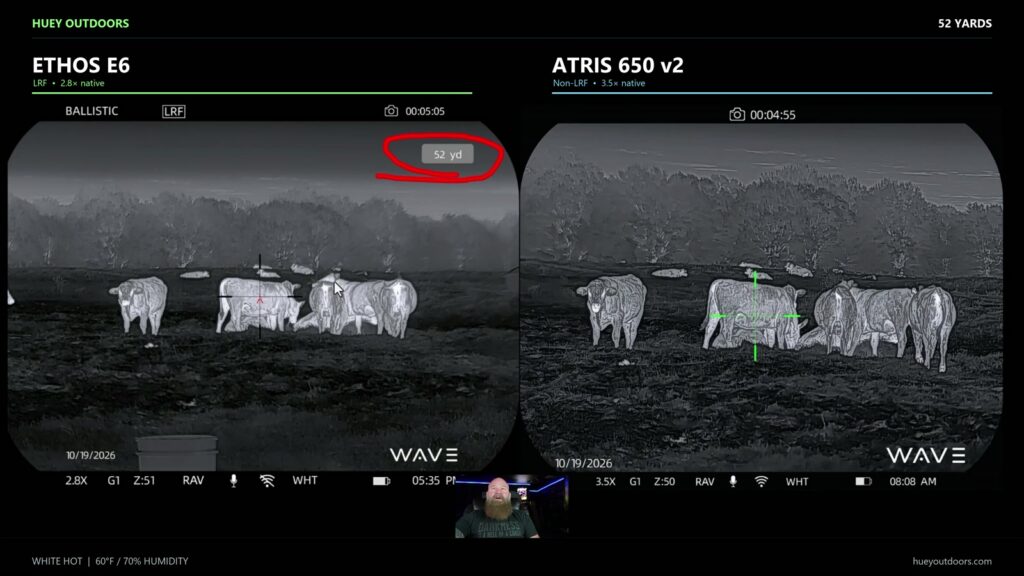
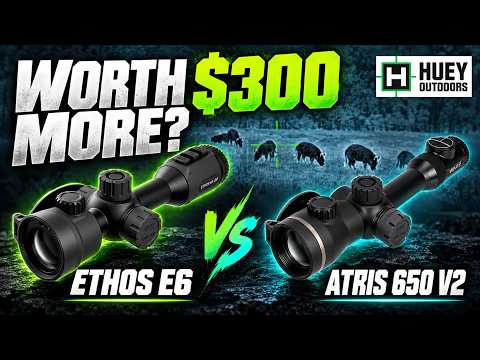
The WAVE ETHOS E6 LRF and WAVE ATRIS 650 V2 were only $300 apart when I recorded this comparison. The ETHOS included a laser rangefinder. The ATRIS I tested did not. That makes this a useful buying question: would I keep the rangefinder and save $300, or spend the extra money for the ATRIS image?
For my own use, I would spend the extra $300 on the ATRIS 650 V2. I preferred the detail in the cattle, grass, and surrounding scene. But the ETHOS E6 has a clear case of its own: a wider view, integrated ranging, and the lower price.
I compared the two on cattle at 52, 93, and 408 yards. Here is what stood out in the footage and what I would consider before choosing either scope.
| Feature | WAVE ETHOS E6 LRF | WAVE ATRIS 650 V2, non-LRF |
|---|---|---|
| Price quoted in the comparison | $2,999 | $3,299 |
| Thermal sensor resolution | 640×512 | 640×512 |
| Laser rangefinder | Included | Not included on the model tested |
| Objective lens diameter | 44mm | 56mm |
| Rated thermal sensitivity (NETD) | Below 18 mK | Below 15 mK |
| Display resolution | 1600×1200 | 2560×2560 |
| Magnification shown in the comparison | 2.8× | 3.5× |
Prices are the amounts quoted in my recording. Check the linked product pages for current pricing and availability. The ATRIS 650 LRF V2 is a separate model; I quoted $3,999 for that version in the recording.
A note on magnification: the ETHOS reads 2.8× in this footage. Its current product listing specifies 2.5× base magnification. The table reports the on-screen setting used in the comparison.
Both scopes have a 640×512 thermal sensor. The ATRIS advantage I am describing is the image produced by the complete scope: its larger objective, lower NETD rating, processing, and higher-resolution display. Moving from the E6 to the ATRIS is not a move to a higher-pixel-count thermal detector.
The side-by-side comparisons show the same cattle on the same night. Conditions were approximately 60°F with 70% humidity. The ETHOS E6 is on the left; the ATRIS 650 V2 is on the right.
I looked at white-hot and black-hot views, the amount of surrounding ground visible, and how animal detail held up as distance increased. For the black-hot comparison, I left the image settings as they came rather than individually tuning contrast to make either one look better.
There is also a limit to what a recording shows. Looking through the eyepieces, I found the display difference more noticeable than it appears in the captured footage. These stills help explain the comparison, but they do not reproduce the full experience of looking through each scope.
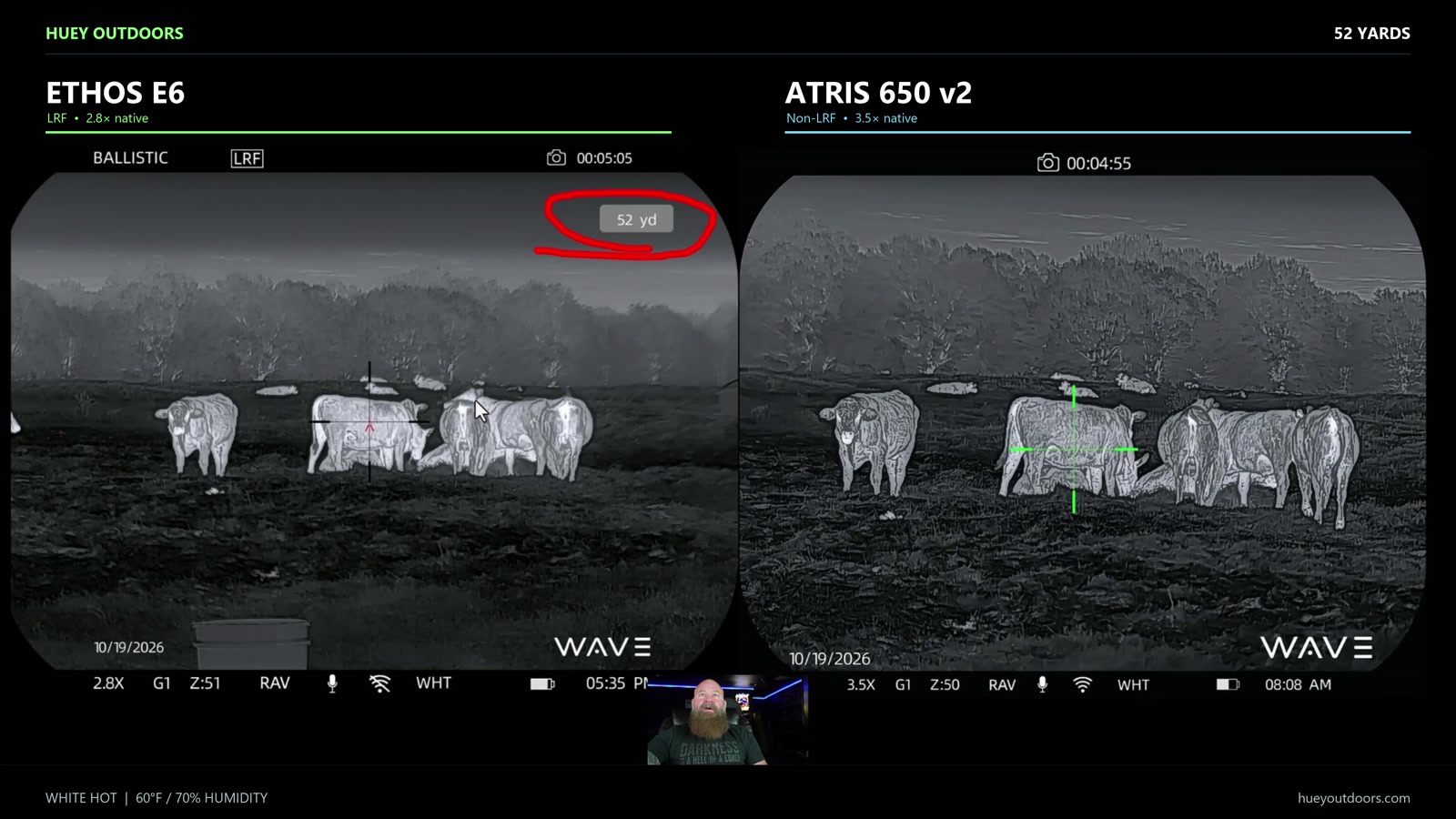
At 52 yards, both scopes showed the cattle clearly. What caught my attention first was the surrounding grass. I could make out more detail on the ATRIS, and I preferred the definition in the animals as well.
That is why I look beyond the brightest animal in the center of an image. The rest of the scene tells you a lot about how the scope presents detail. In this comparison, the ATRIS gave me the stronger overall picture.
The ETHOS showed more space around the cattle. You can see that difference even at this distance. If you value a wider view around a group of animals, that is a practical reason to consider the E6.
At 93 yards, the ATRIS’s higher on-screen magnification was more noticeable. The cattle occupied more of the image, and I found their detail easier to see.
In the black-hot footage, the ATRIS also has a blue tint. That is a display filter available on the ATRIS I tested, rather than a different thermal polarity. Both scopes were in black hot for that comparison. The ETHOS did not offer that same blue display tint in the version I used.
The blue tint is a viewing preference. My reason for favoring the ATRIS was the detail I could see, together with the experience through its eyepiece.
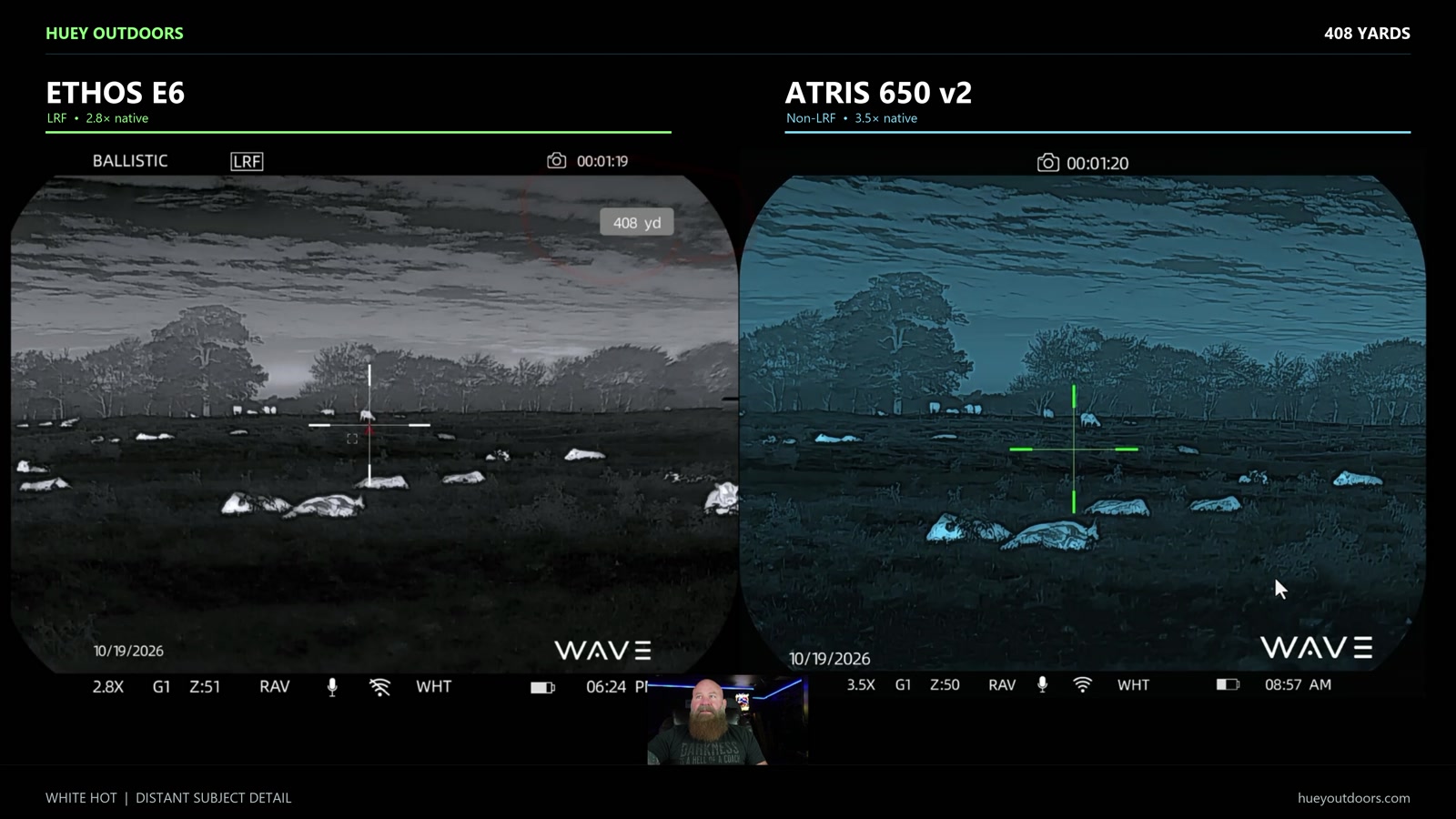
For the 408-yard comparison, both scopes were in white hot, with the blue tint still selected on the ATRIS. I could make out the cow’s head in both images, but it was easier to see on the ATRIS.
The ETHOS still showed the animal. The ATRIS gave me a clearer view of its shape and head in this scene. Those observations apply to the footage and conditions shown here; distance alone does not tell you how much detail a thermal will reveal on every night.
The ETHOS E6’s wider view is the strongest reason I would choose it over the ATRIS in this pair. If you spend your time in thick country or want more room around animals at closer distances, that extra scene can matter more than the ATRIS’s more magnified view.
The ATRIS puts more emphasis on image detail and a larger starting image. That suits my priorities, which is why I leaned toward it in this comparison.
Neither preference makes the other scope a bad choice. I would start with the places you hunt and the view you actually need, then decide how much you value an integrated rangefinder.
Both WAVE scopes let you increase magnification gradually. In the recording, I took the ATRIS to a displayed 14× and the ETHOS to 15×. At those settings, the loss of detail was obvious.
A larger image on the screen is not the same as additional captured detail. I would put more weight on the normal viewing image, field of view, and the detail available before heavy digital zoom than on which scope has the higher maximum number.
I would choose the ATRIS 650 V2 without the rangefinder. At the prices in this comparison, I was willing to give up integrated ranging and spend another $300 for the image I preferred. For me, the ATRIS was the better buy.
The ETHOS E6 LRF may be the better fit if your priorities are:
Both are good scopes. My preference for the ATRIS is based on how I value its image, while the ETHOS offers features that may be more useful for the way you hunt.
Huey Outdoors is my store. I sell thermal and night-vision equipment; I am not a guide service. If you have questions about these two scopes, call 817-668-1001. I answer that line, so you will talk directly with me.
Tell me your budget, usual distances, and the terrain you hunt. I can help you work through the tradeoffs before you buy.
Review by Todd Huey, based on the recorded WAVE ETHOS E6 vs ATRIS 650 V2 field comparison.