

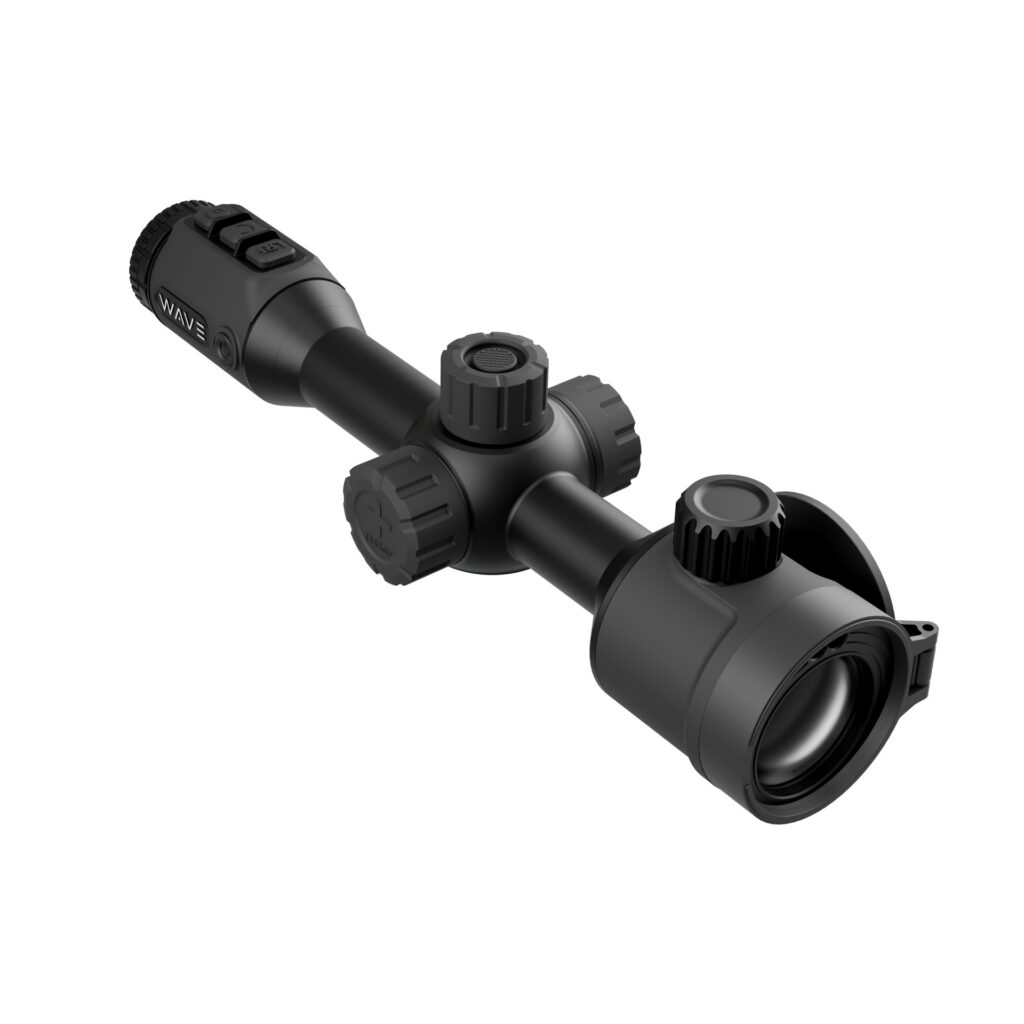
The WAVE ETHOS E3 and E6 are $1,000 apart. Both have a built-in laser rangefinder, onboard ballistics, and a traditional scope body. So what are you getting for the extra money, and will it make a difference for the way you hunt?
The WAVE ETHOS E3 LRF is the $1,999 option, with a 384×288 sensor and 3.5× starting magnification. The WAVE ETHOS E6 LRF is $2,999, with a 640×512 sensor and a wider 2.5× starting view.
Here is how I would choose: the E3 makes sense when the budget is around $2,000 and a tighter view fits your hunting. The E6 is the one I would lean toward for a mix of close cover, open ground, and moving animals.
The reason I would consider spending the extra money on the E6 starts with field of view. That is something you use every time you look through the scope.
My ETHOS comparison video is still to come. This article covers the published specifications and how I would use those differences to make a buying decision.
WAVE lists field of view at 1,000 yards. That is useful for comparing specifications, but I would rather look at what those numbers mean at distances that are easier to picture.
These are approximate horizontal viewing widths at each scope’s base magnification, calculated from WAVE’s published figures:
| Distance | ETHOS E3 at 3.5× | ETHOS E6 at 2.5× |
|---|---|---|
| 50 yards | 19.8 feet wide | 33.5 feet wide |
| 100 yards | 39.5 feet wide | 67 feet wide |
| 200 yards | 79 feet wide | 134 feet wide |
At 100 yards, the E6 shows about 27.5 additional feet from side to side. Its view is roughly 70% wider.
Picture several hogs spread across a field. A wider view gives you more room to keep the group in the image. If an animal changes direction or another one enters the area, you have more of the surrounding scene visible.
The same applies around feeders and timber edges. A scope that feels comfortably magnified across a pasture can feel tight when an animal appears much closer.
That is why I would put real value on the E6’s wider starting view. For someone hunting different properties and changing distances, that extra room can be more useful than a higher magnification number.
The E3 takes the other approach. It starts with a tighter, more magnified view. If you normally watch a particular lane or a predictable part of a field, that may suit you well. You just need to be comfortable with the narrower view when animals get closer.
| Feature | WAVE ETHOS E3 LRF | WAVE ETHOS E6 LRF |
|---|---|---|
| Listed price at Huey Outdoors | $1,999 | $2,999 |
| Thermal sensor | 384×288 | 640×512 |
| Base magnification | 3.5× | 2.5× |
| Magnification including digital zoom | 3.5–14× | 2.5–15× |
| Field of view at 1,000 yards | 395 feet | 670 feet |
| Pixel pitch and refresh rate | 12 microns / 50 Hz | 12 microns / 50 Hz |
| Thermal sensitivity | NETD below 18 mK | NETD below 18 mK |
| Objective lens diameter | 44mm | 44mm |
| Display resolution | 1600×1200 | 1600×1200 |
| Laser rangefinder rating | Up to 1,300 yards on reflective targets | Up to 1,300 yards on reflective targets |
| Onboard ballistic calculation | Yes | Yes |
| Scope tube | 30mm | 30mm |
| Listed weight without battery | 36 ounces | 36 ounces |
Specifications are manufacturer ratings. The 44mm measurement is objective diameter; it should not be treated as a confirmed focal length. Prices and availability can change. Check the linked product pages for current details.
The E3 has 110,592 detector pixels. The E6 has 327,680. That gives the E6 nearly three times as many total pixels across the complete image.
That matters, but it needs some context.
Those additional pixels also cover a much wider scene. They do not automatically put three times as much detail on an individual hog at the same distance. Lens design, field of view, focus, processing, and conditions all affect what you can actually make out.
For this particular comparison, the wider view is the advantage we can clearly establish from the specifications. How the two images compare on the same animal, on the same night, is something field footage can show much better than a resolution label.
I would also be careful about choosing between them based on the advertised 14× and 15× maximum magnification. Those numbers include digital zoom.
Digital zoom enlarges a smaller part of the captured image. At 2× digital zoom, a conventional crop uses about half the sensor width and half its height, leaving approximately one-quarter of the original pixels:
Those examples compare the same digital-zoom multiplier. Because the starting magnifications differ, that would be about 7× total magnification on the E3 and 5× on the E6. It is not a comparison at equal total magnification.
The E6 has more total image information available, but digital zoom still has a cost on both scopes. A larger image on the screen does not necessarily reveal something the sensor could not resolve in the first place.
I explain the relationship between resolution, lens design, field of view, and digital zoom in more detail in 640 vs 1280 Thermal Scopes: What Do You Actually Gain? That article compares different sensor sizes, but the same basic principles apply here.
The E3 keeps much of the same equipment as the E6. The price difference primarily buys a different imaging configuration and view, rather than an entirely different set of features.
Both use a 30mm tube, with a listed length of 13 inches. That gives you a familiar mounting arrangement and lets you select compatible rings or a mount for your rifle.
Both weigh 36 ounces before adding the battery. Include the battery and mounting hardware when you are thinking about the complete weight on your rifle.
Both have WAVE’s DeadEye laser rangefinder and onboard ballistic calculation. WAVE rates the rangefinder to a maximum of 1,300 yards on suitable reflective targets.
That is a maximum rating under suitable conditions. It is not a promise that a hog or coyote will return a reading at that distance. The target and weather matter.
From a buying standpoint, the useful point is that choosing the E3 still gets you integrated ranging and ballistics. You do not have to move up to the E6 just to get those features.
Both are rated below 18 mK NETD. That describes sensitivity to small temperature differences, which matters when an animal and its surroundings have little thermal contrast.
I pay attention to that because a sharp-looking image in favorable conditions only tells part of the story. Humidity and changing temperatures can make a much harder test.
What matters to me is what the complete scope does on a humid Texas night. The sensitivity number is useful, but the lens, focus, and processing all have to do their part.
Both support photos, video, optional audio, recoil-activated recording, and Wi-Fi. They also have picture-in-picture viewing and multiple color palettes.
Each runs on a protected 26650 battery, with a sleeved 18650 option. WAVE lists approximately 10 hours of expected runtime. Treat that as an estimate; temperature, battery condition, and feature use affect how long it lasts.
Both new models carry WAVE’s five-year transferable limited warranty, subject to the manufacturer’s terms.
The WAVE ETHOS E3 LRF is the one I would consider first if $2,000 is the budget and the 3.5× starting view matches the places you hunt.
Maybe you usually sit over a field, watch a known lane, or hunt a feeder at a fairly consistent distance. In that situation, a wide view may be less important to you than it is to someone working different properties every night.
The E3 also makes sense for a buyer who wants a traditional tube scope with integrated ranging and ballistics while keeping another $1,000 in the budget.
I would not dismiss it just because it says 384. I would ask whether the complete scope fits the job. At the same time, I would not call its higher base magnification proof that it identifies animals farther away than the E6. Apparent image size and resolved detail are different things.
The E3’s case is price, a more magnified starting image, and the shared ETHOS features.
The WAVE ETHOS E6 LRF would be my starting recommendation within this pair for someone who can comfortably spend $2,999 and wants one scope for a variety of hunting situations.
That recommendation is based on the wider view and larger sensor. It is especially relevant if your nights involve a mix of feeders, field edges, closer encounters, and animals moving across open ground.
The E6’s 2.5× starting magnification gives you more space around the animal. You can enlarge the image when needed, although digital zoom reduces that wider view and the amount of sensor information being displayed.
You cannot make the E3 show the E6’s full native field of view by turning its magnification down. Its starting view is already the widest it provides.
That is the practical difference I would be paying for. If a narrow view regularly gets in your way, the E6 addresses that directly.
If your hunting is predictable and the E3’s view fits it, the extra $1,000 may be harder to justify. Your terrain and priorities should make that decision.
If you are also considering the ATRIS, read my WAVE ETHOS E6 vs ATRIS 650 V2 field review. It compares the two 640 models at 52, 93, and 408 yards and explains why I would trade the ETHOS rangefinder for the ATRIS image at a $300 difference.
No. Lower starting magnification can be an advantage when animals are close or moving because you see more of the surrounding area. Whether 2.5× or 3.5× suits you better depends on your distances and how much scene you want visible.
No. The display is the screen you look at through the eyepiece. The thermal sensor captures the image information. The E3 remains a 384×288 thermal, and the E6 remains a 640×512 thermal, even though their display resolutions match.
There is no honest single distance that covers every animal and every night. Size, weather, contrast, focus, and the view available all matter. Seeing a heat source is different from knowing what it is. I would not use a manufacturer’s maximum detection rating as an identification-distance promise.
I would start with the distance and the area around it. A closer feeder with animals approaching from several directions favors the E6’s wider view. A predictable approach farther out may suit the E3’s tighter view. Saying “feeder hunting” by itself does not tell us enough to pick the right scope.
If you know me through Lone Star Boars, Huey Outdoors is my store. You can buy both ETHOS models directly from me, and I can help you compare them with the other scopes you are considering.
Tell me what you hunt, your usual distances, the terrain, and your budget. That is where I would start before recommending either one.
Call Huey Outdoors at (817) 668-1001 or email todd@hueyoutdoors.com.