

There are pieces of hunting equipment I like, and then there are pieces of equipment that completely change the way I hunt.
A vehicle-mounted thermal pan-tilt-zoom camera falls into the second category.
I have said this many times: other than a thermal weapon sight, I would give up my drones, helmet-mounted thermals, handheld monoculars, and binoculars before I gave up my thermal PTZ.
That may sound excessive until you actually use one.
A roof-mounted thermal camera lets you sit inside your truck, UTV, or ATV with the windows closed while the camera scans outside. Everyone in the vehicle can see the same image on the monitor. The camera is higher than your head, giving it a better chance of seeing over fences, vegetation, low spots, and other obstructions.
You can pan left and right, tilt up and down, and digitally zoom without leaning out the window or holding a thermal monocular for hours.
The Dark30 Defiance system is available in two thermal resolutions:
The two systems share the same basic vehicle-mounted concept, but there is a major price and performance difference between them.
At the time of this article, the 384 model is being discontinued and sold for approximately $1,999.97 while remaining inventory lasts. The 640 model remains the premium current version at approximately $6,500.
That raises the obvious question:
Is the 640 worth more than three times the price, or is the 384 good enough for the way you hunt?
I have used both systems in the field and recorded them side by side on the same animals at the same time.
My answer is:
The 384 is an exceptional value and more than usable for normal hog, predator, and ranch work. The 640 provides a noticeably wider view, more detail, quicker target identification, and a better overall experience for hunters who use a PTZ heavily and can justify the additional cost.
Neither answer is right for everyone.
This comparison will help you decide which one fits the way you actually hunt.
Shop the Dark30 Defiance LS 384 PTZ at Huey Outdoors
Shop the Dark 30 Defiance 640 PTZ at Huey Outdoors
PTZ stands for:
The camera can rotate continuously to scan around the vehicle, tilt vertically, and digitally magnify the image.
The included remote lets the operator control the camera without touching the unit mounted on the roof.
Both systems can send the thermal image to the included dash monitor. The system can also connect to a phone or tablet through the Dark30 app.
I prefer the dedicated monitor because the direct wired connection provides a clean, low-latency image and does not require me to rely on a phone screen.
The app is still extremely useful.
A passenger in the rear seat can watch on a phone or tablet without leaning forward to see the main monitor. Depending on the setup, another passenger can also help operate the camera while the driver concentrates on safely operating the vehicle.
Thermal cannot see through ordinary glass.
If you are using a handheld thermal monocular inside a vehicle, you cannot scan through the windshield. You have to:
That gets old quickly.
In the winter, cold air enters the vehicle.
In the summer, mosquitoes and heat enter the vehicle.
If it is raining, you and the equipment may get wet.
After several hours, even a lightweight monocular becomes tiring to hold and scan with continuously.
With the Dark30 mounted outside, you can leave the windows closed, run the heater or air conditioning, and scan from the monitor.
For me, that means I can hunt longer and remain more alert.
Operating the remote and watching the screen also gives me something active to concentrate on. There have been nights when I was becoming tired but using the PTZ kept me engaged for another couple of hours.
The camera does not need to be mounted extremely high to provide an advantage.
Even one additional foot of elevation can help the camera see:
I have seen animals on the PTZ screen that I could not see when looking through the side window.
The animal did not disappear from the field. My eyes were simply lower than the roof-mounted camera.
In one field example, pigs were approximately 200 yards away in a low area among cut corn rows. The people inside the truck could not see them directly. One person had to climb partly out of the window with a helmet-mounted thermal, while the roof-mounted PTZ already showed the group.
That elevated view is one of the system’s biggest practical advantages.
| Feature | Defiance LS 384 PTZ | Defiance 640 PTZ |
|---|---|---|
| Thermal sensor | 384×288 | 640×480 |
| Total detector pixels | 110,592 | 307,200 |
| Pixel advantage | — | About 2.8× more total pixels |
| Frame rate | 60 fps | 60 fps |
| Thermal sensitivity | Listed below 40 mK | Listed below 30 mK |
| Pixel pitch | 17 microns | 17 microns |
| Lens | 30mm F1.0 | 30mm focal length, 32mm objective, F1.0 |
| Digital zoom | 1–8× | 1–8× |
| Field view in my footage | Narrower | Noticeably wider |
| Published detection range | Approximately 1,258 yards | Approximately 1,258 yards |
| Continuous pan | 360° | 360° |
| Included dash display | 10.1 inches | 10.1 inches |
| App control | Yes | Yes |
| Temporary mounting | Magnets or suction cups | Magnets or suction cups |
| Permanent mounting | Yes | Yes |
| Weather protection | IP66 | IP66 |
| Warranty | Five years | Five years |
| Current status | Being discontinued | Current premium model |
| Approximate price at publication | $1,999.97 | Approximately $6,500 |
| Best fit | Maximum value | Maximum performance |
The 640 has approximately 2.8 times as many detector pixels as the 384.
That does not mean it produces exactly 2.8 times the visible detail in every condition. Lens quality, focus, thermal sensitivity, processing, weather, display quality, and viewing distance all affect the final image.
It does mean the 640 begins with substantially more captured thermal information.
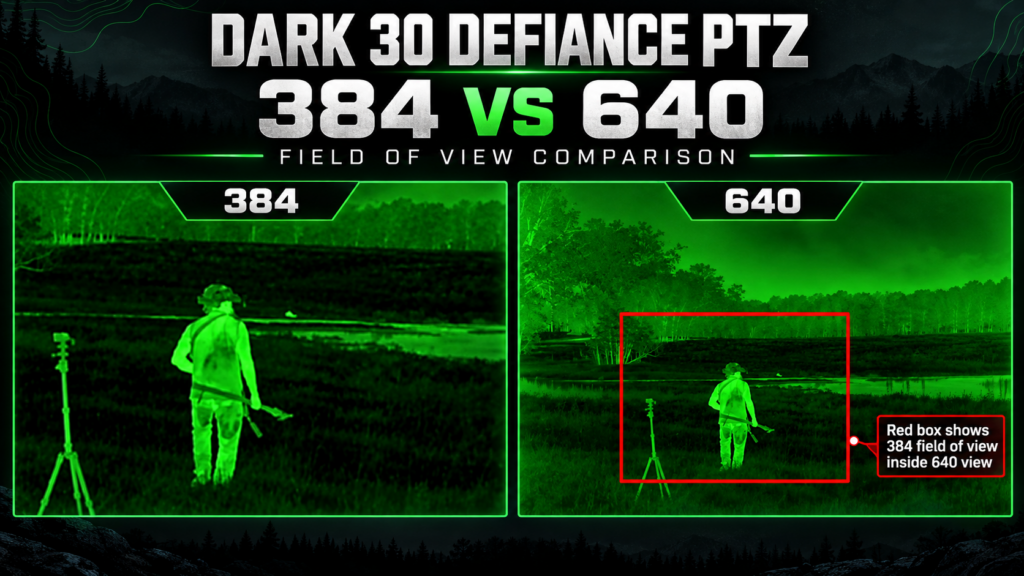
The currently published field-of-view specifications for the 384 are inconsistent between product listings.
Rather than claim an exact percentage that I cannot defend, I rely on what I recorded with both cameras aimed at the same scene.
In my side-by-side footage, the 640 clearly showed more of the area around the target.
Animals appeared on the outer edges of the 640 image that were completely outside the 384 image.
That difference matters more to me than arguing over a specification table.
Most people expect resolution to be the main difference between the 384 and the 640.
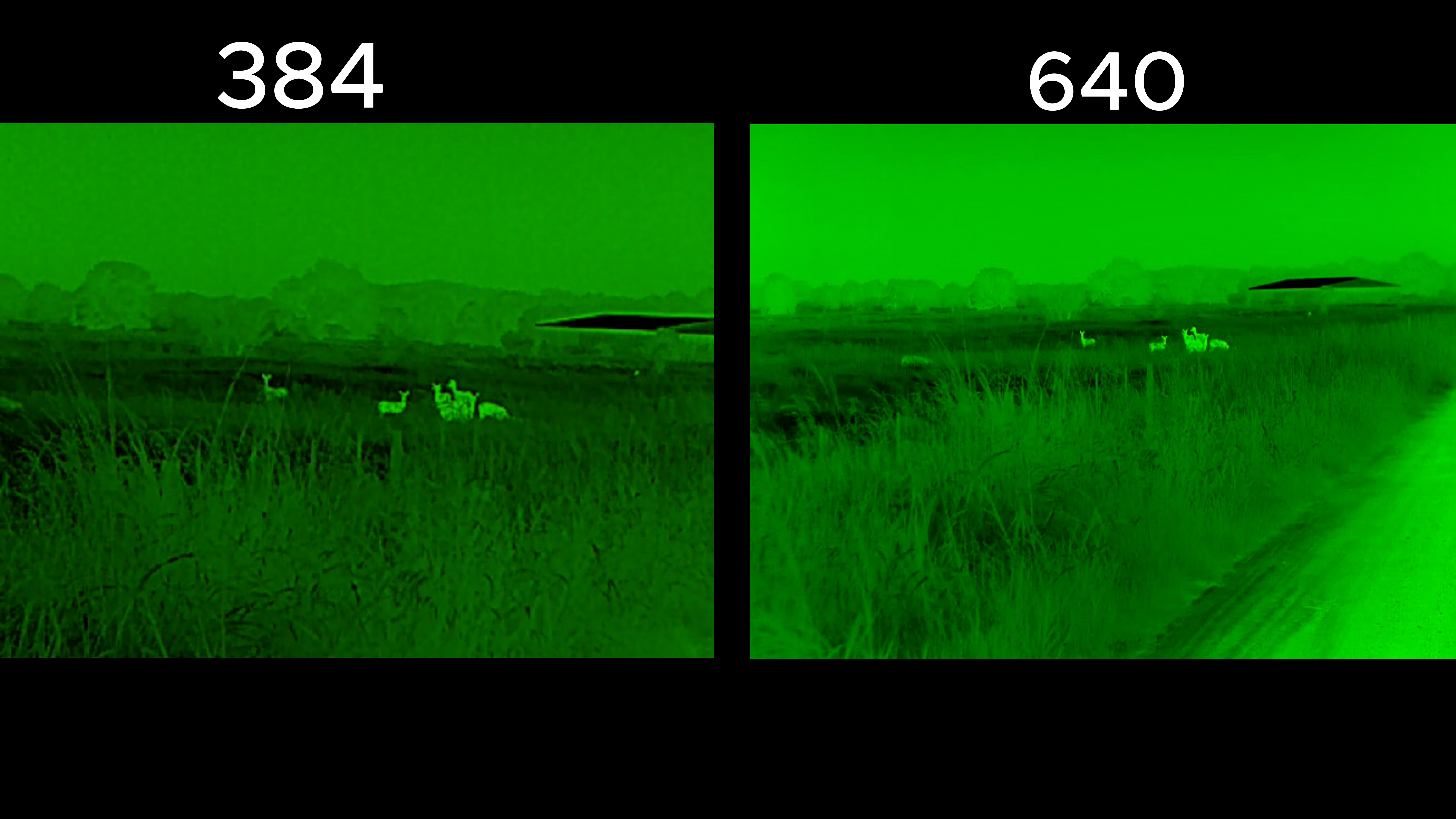
Resolution is important, but the wider view of the 640 may be even more valuable while scanning from a moving vehicle.
When both cameras were aimed toward the same animals, the 640 showed a much larger section of the field.
In one comparison:
That means the 384 operator has to pan back and forth more frequently to cover the same area.
If an animal is standing in a roadside ditch or near the edge of the field, it is easier to miss with the narrower view.
The 640 does not eliminate the need to scan carefully, but it gives you more visual coverage on every pass.
A wider field of view also makes vibration appear less severe.
Action cameras such as GoPros commonly use wide-angle lenses partly because a wide view makes motion look more stable.
The same general effect appears in thermal PTZ footage.
When the truck was sitting unevenly or wind was moving the camera slightly, the narrower 384 image made the vibration more noticeable.
The 640 image appeared steadier because more of the scene remained visible.
That does not mean the 640 has electronic stabilization that the 384 lacks. It means the wider view makes the same movement less distracting.
Both systems were still usable while moving.
On a very rough farm road, both images bounced because the entire truck was moving through the field.
On a smoother road, both were much easier to watch.
The 640 remained the more comfortable image, especially when scanning while the vehicle was moving.
The 384 is lower resolution, but it is not a toy.
I used the Defiance LS 384 for approximately a month before recording my comparison.
During that time, I had no major problem using it to locate and identify animals.
In the side-by-side footage:
Those are field estimates, not controlled laboratory measurements.
The important point is that the 384 remained useful at distances well beyond where most hog shots occur.
At longer distances, I may have to stop and watch the animal move for a moment to distinguish a hog from a calf or another similarly sized heat source.
The 640 makes that decision easier and faster.
But the 384 still gave me enough information to hunt effectively.
In one sequence, I approached a hog carrying a rifle, shooting sticks, and wearing a helmet.
The 384 image showed enough detail to recognize:
During the shot, the 384 footage also showed small heat and movement details around the animal.
The image was not as refined as the 640, but it was more than sufficient for the job.
For approximately $2,000, you are receiving an entire vehicle-mounted thermal system for roughly the price of many handheld monoculars.
That is why I describe the 384 as such a strong value.
The 640 delivers the better image.
That should not be surprising.
It has:
The improvement is not limited to making the animal look prettier.
More resolution and sensitivity help reveal:
Those details improve situational awareness.
When several animals are spread across a field, the 640 makes it easier to understand the complete scene rather than concentrating on one bright heat source.
There is a difference between detecting a heat source and identifying it.
Both PTZ systems can detect heat at long distances.
Identification requires enough detail to determine whether the heat source is:
With the 384, you may occasionally need to stop, focus, watch the animal move, or change palettes before being completely confident.
The 640 normally gives you that answer faster.
For occasional use, the added time may not matter.
For someone who hunts several nights per week, patrols large ranches, or scans continuously while driving, faster identification adds up over an entire night.
The 384 and 640 share many of the same advantages.
Both provide:
Both systems let everyone inside the vehicle see the same thermal image.
That makes planning easier.
Instead of one person describing an animal seen through a monocular, every passenger can see:
That shared view is a major advantage when hunting with multiple people.
The system can be viewed through the included monitor or the Dark30 mobile app.
I prefer the dedicated monitor.
The monitor provides:
The phone or tablet option remains useful.
A passenger in the rear seat can watch the same view without leaning forward. Someone outside the vehicle can also use a mobile device, depending on the connection and operating setup.
The best arrangement may be the monitor for the main operator and the app for additional passengers.
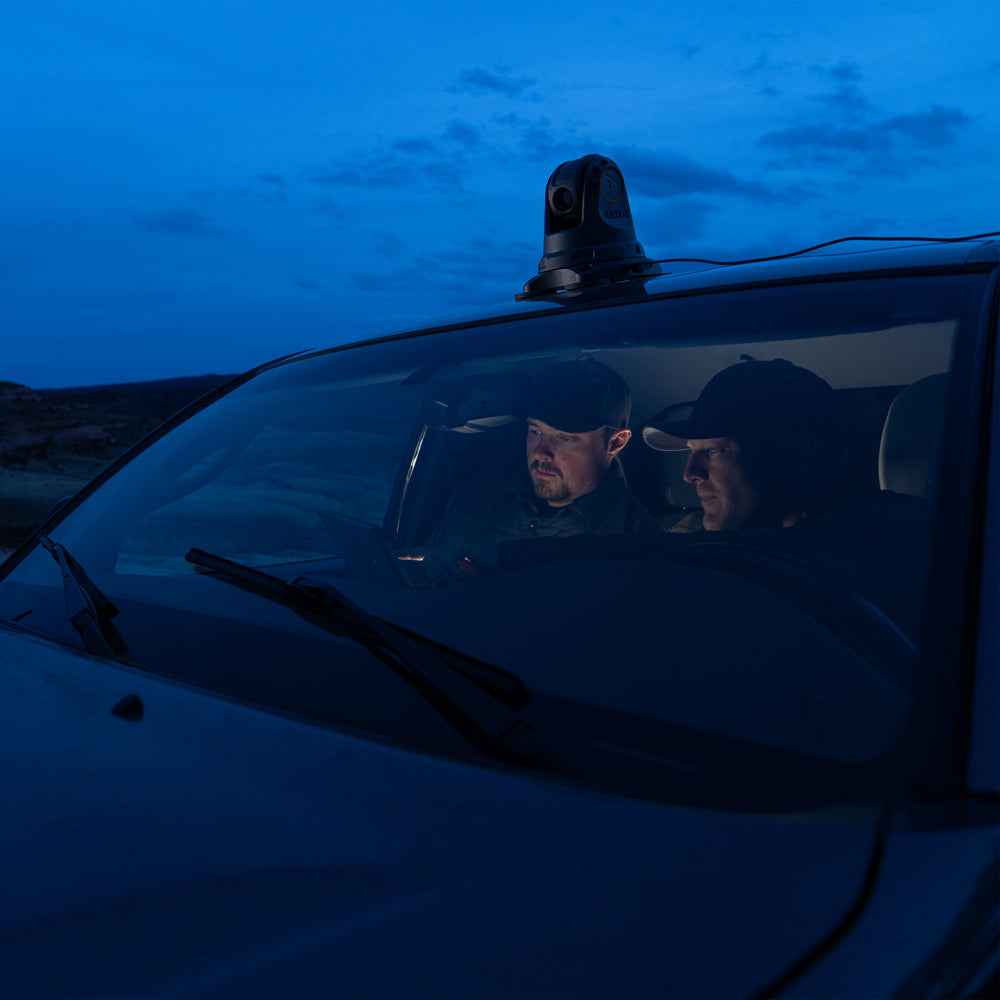
The system includes several mounting options.
The magnetic feet work well on a steel roof.
Once attached, they can be surprisingly difficult to remove.
Many newer Ford trucks use aluminum body panels, so magnets will not work.
The included suction mounts can be used, but for regular use or highway travel, I prefer a properly installed hard mount or purpose-built plate. 3m also makes a stick on metal plate.
Suction mounts can work on a suitable smooth surface.
I have also used straps and custom mounting solutions on side-by-sides and utility vehicles.
For a dedicated hunting truck, the best long-term option is normally a secure hard mount attached to a roof rack, mounting plate, or another properly reinforced structure.
A secure mount reduces vibration and removes the concern of a temporary mount loosening during travel.
Riser blocks can raise the camera above the roof.
Every additional amount of height can improve the view over fences and low terrain.
However, height also creates leverage.
On a thin vehicle roof:
On my dedicated roof-rack mounting system, I could use more height because the mount was welded and bolted securely to the truck.
The correct setup depends on the vehicle.
Do not assume that a temporary suction or magnetic mounting arrangement is suitable for high-speed highway travel merely because it worked at lower speeds.
Mount the system appropriately for the way it will be used.
The Defiance system offers several recording options.
Depending on the model and setup, footage can be recorded:
The 640’s onboard audio impressed me.
In one field example, pigs were several hundred yards away. The camera recorded:
That opens additional possibilities for hunters who want to document hunts, review what happened, or create social-media and YouTube footage.
Screen recording from a phone or tablet may not capture the system’s external audio in the same way, so choose the recording method based on what you want to preserve.
Both systems include multiple color palettes.
The most useful options depend on the environment and personal preference.
Common choices include:
White Hot and Black Hot remain the most natural choices for many hunters.
Green can be easier on the eyes during long nights.
Color palettes can make temperature differences easier to recognize in certain scenes, but they do not change the native resolution of the thermal sensor.
Thermal can remain useful in darkness, light fog, smoke, and conditions that make normal visible-light viewing difficult.
It is not magic.
Heavy rain, dense fog, and high humidity can still reduce thermal contrast and detection performance.
In my own use, the 640 system has helped me see people and animals that were invisible to my eyes and headlights.
On one late-night drive through the East Texas woods, I detected a person riding a bicycle in the road while wearing dark clothing with no visible reflectors.
Fog and darkness made him nearly invisible through the windshield.
The roof-mounted thermal showed him well before my eyes did.
That experience demonstrated that this system can have value beyond hunting.
My primary use is hog and predator hunting, but the PTZ design can also be useful for:
A camera can be mounted on a pole, roof, stand, vehicle, or permanent structure as long as the mounting, power, and cabling are handled correctly.
The 384 makes the most sense for someone who wants:
The 384 is especially compelling for someone who previously believed a PTZ system was financially out of reach.
At approximately $2,000, it offers a tremendous amount of capability.
The 640 makes more sense for someone who:
For the way I hunt, the PTZ is one of the most important tools I own.
If I were using the system almost every night, the wider view and improved identification of the 640 would be worth far more to me than they might be to an occasional hunter.
That depends entirely on how much you use it.
The 384 performs the central job:
The 640 performs that same job better.
It gives you:
For an occasional user, the 384 may deliver most of the practical benefit for far less money.
For a professional, land manager, outfitter, eradication hunter, or serious night hunter who uses the camera constantly, the 640’s advantages become much easier to justify.
The Dark30 Defiance LS 384 PTZ may be one of the best values I have seen in vehicle-mounted thermal equipment.
It is not as clear as the 640.
It does not show as much of the field.
At longer distances, you may need to watch the target move before being completely certain what it is.
But it remains highly usable.
I hunted with it for approximately a month and had no major difficulty locating or identifying animals at normal hunting distances.
For approximately $2,000, the 384 delivers a complete roof-mounted thermal system for the price of many handheld monoculars.
The Defiance 640 is still the better system.
It gives me the wider view, detail, faster identification, and overall performance I want when the PTZ is one of the main tools being used throughout the night.
My recommendation is:
Buy the Defiance LS 384 if getting into a complete PTZ system at the lowest possible cost is the priority. Buy the Defiance 640 if the system will be used heavily and you want the best field of view, image quality, and target-identification performance available in the Dark30 platform. I personally use the 640.
The 384 is the value pick.
The 640 is the performance pick.
Either one changes the way you hunt from a vehicle.
Shop the Dark30 Defiance LS 384 PTZ at Huey Outdoors
Shop the Dark 30 Defiance 640 PTZ at Huey Outdoors
Huey Outdoors offers free ground shipping on qualifying orders and covers the sales tax for the customer.
PTZ means pan, tilt, and zoom. The camera rotates horizontally, tilts vertically, and digitally magnifies the thermal image.
No. Ordinary glass blocks the infrared energy used by the thermal camera. The camera must be mounted outside the vehicle, while the image is displayed on a monitor inside.
Yes, for many hunters. In my field use, the 384 clearly detected and identified hogs, deer, cattle, and people at normal hunting distances.
The 640 makes identification easier and provides more detail, but the 384 remains a useful hunting system.
A 640×480 sensor contains approximately 2.8 times as many detector pixels as a 384×288 sensor.
That provides more captured thermal information, although final image quality also depends on the lens, sensitivity, processing, weather, and display.
In my direct side-by-side field footage, the 640 showed substantially more of the scene.
Some currently published specifications conflict on the exact 384 field-of-view measurement, so I rely on the real comparison footage rather than claim an unsupported percentage.
Yes. Both use a 10.1-inch dash monitor with a direct wired connection.
Yes. The Dark30 app supports viewing and control through compatible mobile devices.
Yes. Both systems provide continuous 360° horizontal panning.
Magnets will not attach to an aluminum body.
The included suction mounts may be used on a suitable smooth surface, but a properly installed hard mount or mounting plate is preferable for regular or higher-speed use.
Yes. Depending on the UTV roof and body material, the system can be mounted using suction cups, permanent hardware, a custom bracket, or another properly secured mounting solution.
Both support recording. Available audio and recording behavior depend on the selected recording method and system configuration.
Both systems use IP66-rated housings designed to resist dust and weather exposure.
The published maximum detection figure is approximately 1,258 yards under favorable conditions.
Detection means recognizing that a heat source is present. Positive identification distance is shorter and depends on the animal, weather, humidity, terrain, focus, and viewing conditions.
Yes. The 384 model is being sold while remaining inventory lasts. The 640 model remains the current premium Defiance PTZ.
Choose the 384 when price and overall value are the priorities.
Choose the 640 when field of view, image detail, faster identification, and frequent heavy use are more important than price.